
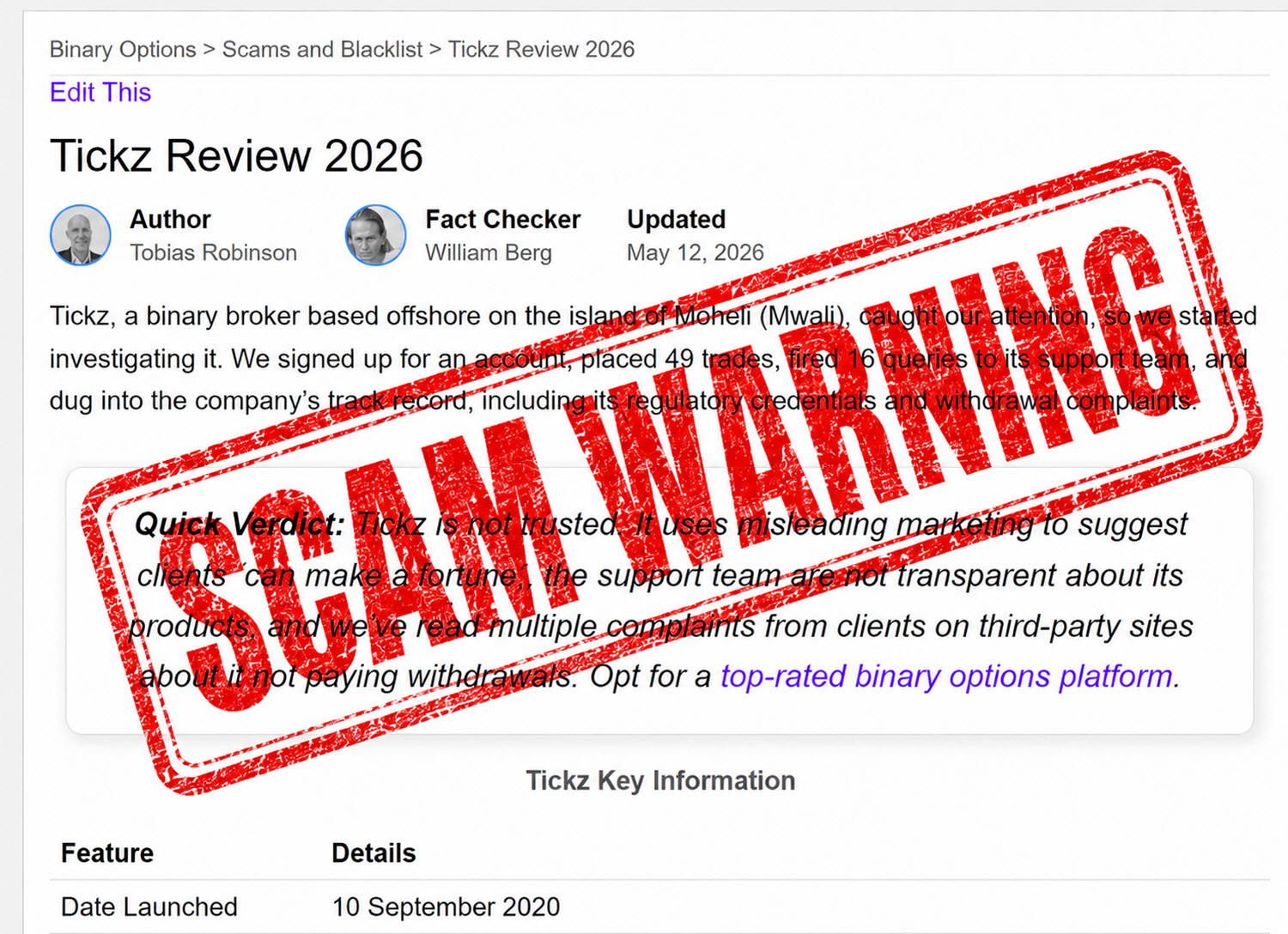
BinaryOptions.net issues warning on Tickz
BinaryOptions.net has warned traders against using Tickz after reviewing the offshore binary options platform and concluding that it should not be trusted. The broker review, available at BinaryOptions.net’s Tickz review, says the site opened an account, placed 49 trades, sent 16 support queries, reviewed the company’s regulatory position, and checked third party withdrawal complaints before publishing its verdict.
The conclusion was direct. BinaryOptions.net says Tickz uses misleading marketing, lacks meaningful regulatory safeguards, is evasive about the nature of its products, and has attracted complaints from users who say withdrawals were delayed or not paid. The broader broker and market education section can be accessed through the BinaryOptions.net index page.
The review says Tickz is operated by Trusteo Ltd and registered offshore with the Mwali International Services Authority in the Comoros Union. BinaryOptions.net found that the company’s MISA record showed an active status but also displayed a licence end date of February 17, 2025. More importantly, the review argues that this kind of offshore registration does not give retail traders strong practical protection, particularly around segregated client funds, compensation schemes, or strong dispute channels. The attached review text states that BinaryOptions.net added Tickz to its list of binary options operators to avoid after finding misleading claims, withdrawal complaints, and concerning terms.
For traders, the warning is a reminder that a working platform does not automatically mean a safe platform. Tickz offers a low minimum deposit, a simple trading interface, and payment methods including cards, digital wallets, crypto and exchange linked payment options. Those features may make onboarding easy, but ease of deposit is not the same thing as client protection. The harder questions are who runs the platform, what regulator can intervene, how withdrawals are handled, and what rights a trader has if something goes wrong.
Main concerns raised in the review
BinaryOptions.net’s first concern is Tickz’s marketing. The review highlights wording that suggests users can “make a fortune” and that trading can be “surprisingly simple.” That language is risky in binary options because the product can look easy from the outside. A trader chooses a direction, selects a timeframe, enters a stake, and receives a fixed payout if the call is correct. If the call is wrong, the stake is lost. The mechanics are simple. Making money from them consistently is not.
BinaryOptions.net says this kind of language distorts the reality that most retail traders struggle with short term speculative products. Binary options demand timing, risk control, market understanding, and discipline. Presenting them as a simple route to profit is not just optimistic marketing. It can encourage beginners to treat a high risk product as a casual punt with a polished interface.
The second major concern is regulation. Tickz claims a registration through MISA, but BinaryOptions.net argues that this does not amount to strong oversight for retail clients. This matters because traders often see the word “regulated” and assume it means meaningful protection. It may not. A licence in one offshore jurisdiction can be very different from authorisation by a regulator with strict conduct rules, compensation arrangements, capital requirements, and established complaint handling.
The third concern is product transparency. BinaryOptions.net says Tickz refused to acknowledge that it offers binary options, despite the platform’s trade structure matching binary style contracts. According to the review, users choose a market direction through buy and sell buttons, select expiries from five seconds to five hours, stake from $1, and either receive a fixed percentage payout or lose the stake. If that is not being clearly described to customers, the problem is not semantics. It is transparency.
Withdrawal complaints are another core issue. BinaryOptions.net says it found 14 Google Play complaints about withdrawals being delayed or not paid. It also noted that Trustpilot had placed a warning on Tickz after detecting suspicious features about the company. The review carefully frames one part as suspicion, saying it cannot prove whether fake positive reviews were used to drown out complaints. Even so, the wider issue remains practical and serious. Traders were publicly complaining that they could not get money out.
The terms and conditions also drew criticism. BinaryOptions.net highlighted clauses including a possible withdrawal commission of up to 20%, a dispute cap tied to deposits only, the ability to hold an initial deposit for 180 days over documentation, and governing law in the Union of the Comoros. For a retail trader outside that jurisdiction, those terms can make any dispute costly, slow, and awkward. Fine print is boring until it blocks the exit door. Then it becomes very interesting, very quickly.
Why traders should treat binary platforms carefully
Binary options are already a high risk product. The payout is fixed, the expiry can be very short, and the trader often has little room for error. That structure appeals to some traders because the risk and reward are visible before entry. It also attracts weak operators because the product can be marketed as fast, simple, and beginner friendly.
Regulators have warned about binary options fraud for years. The CFTC’s binary options fraud page warns that many online binary options platforms operate offshore and that complaints often involve refusal to return funds, identity theft, and manipulation of trading software. The SEC’s investor education site has also warned that internet based binary options platforms may refuse withdrawals, ignore account credit requests, or manipulate software to generate losing trades. The FCA has warned UK consumers that binary options scam firms may use professional looking websites, fake UK addresses, and manipulated software to appear legitimate.
That background matters when reading the Tickz warning. The point is not that every binary options platform is automatically fraudulent. The point is that traders should demand stronger proof before trusting any platform in a sector with a long history of complaints. If the operator is offshore, the product is poorly explained, support dodges direct questions, and withdrawals attract public complaints, the risk profile changes fast.
How to stay safe before funding an account
The safest approach starts before the first deposit. Traders should identify the legal entity behind the brand and check whether that entity is authorised by a regulator that offers meaningful consumer protection. A brand name, logo, app download page, or registration badge is not enough. The legal company, regulator, licence status, website domain, and payment beneficiary should all match.
For UK traders, the FCA register and warning list are the natural starting points. For US traders, checks may include the CFTC, SEC, FINRA BrokerCheck, and the NFA BASIC database, depending on the product and the claims being made. A trader should not rely on links sent by the platform. The safer method is to go directly to the regulator’s own website and search from there.
Payment details deserve the same caution. If the trading brand is one name but the payment recipient is another, stop and ask why. If crypto is the preferred method, understand that recovery can be difficult once funds move. If a platform makes deposits instant but withdrawals slow, conditional, or expensive, that is not a minor inconvenience. It is a central risk.
Reading the terms before depositing is also basic risk control. Look for withdrawal charges, inactivity fees, bonus conditions, limits on disputes, broad discretion to freeze accounts, and governing law clauses. The Tickz review shows why this matters. A trader may focus on payouts and asset lists, while the real risk sits quietly in the client agreement.
A small test deposit can help, but it should never be mistaken for full verification. Some unsafe platforms allow early withdrawals to build confidence before blocking larger sums. A better approach is to keep exposure low until the firm has passed legal, operational, payment, and withdrawal checks over time.
Traders should also be wary of platform design that nudges constant activity. BinaryOptions.net criticised Tickz for gamification features, including moving icons that encourage deposits and social trading style battles. That sort of design may increase engagement, but engagement is not the same as disciplined trading. A sensible trader sets stake limits, session rules, and stop points before opening the platform. Otherwise the platform starts setting the rhythm.
What to do if withdrawals are delayed
If a platform delays withdrawals, traders should stop sending more money. Do not pay extra release fees, tax payments, insurance charges, or compliance deposits unless the demand is independently verified through a trusted source. These requests are common in financial scams.
Evidence should be preserved immediately. Save account screenshots, trade history, withdrawal requests, chat logs, emails, payment confirmations, wallet addresses, and the terms that applied when the account was opened. Then contact the bank, card provider, wallet provider, or exchange used to fund the account. Reporting may also be appropriate through the FCA, CFTC, SEC, FINRA, NFA, or local consumer protection authorities.
The last warning is simple. Be careful of recovery agents who appear after a loss and promise to retrieve funds for an upfront fee. That is often the second scam. Same wound, new invoice.
This article was last updated on: May 20, 2026