
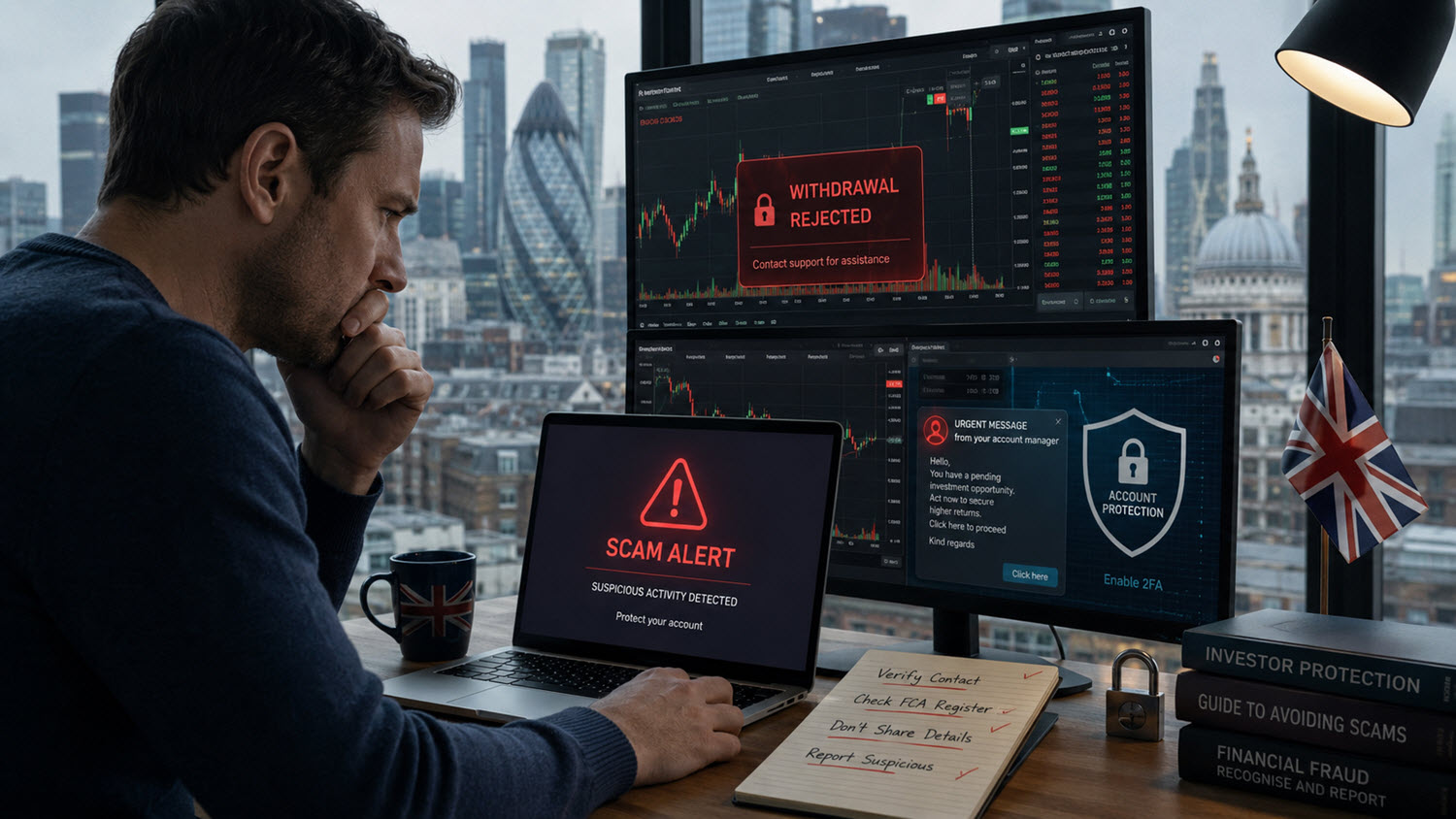
BinaryOptions.co.uk warns that scam risk is rising in 2026
BinaryOptions.co.uk is warning traders and investors to treat new binary options offers, AI trading systems, social media investment groups, and offshore broker promotions with greater suspicion in 2026. The basic message is not complicated: if a platform offers quick access, high payouts, private signals, or “AI assisted” profits without clear regulation and verified ownership, the risk is not theoretical. It is sitting right there on the deposit page.
The warning comes at a time when UK investors are facing two pressures at once. The first is familiar: online trading scams built around urgency, high returns, fake platforms, and blocked withdrawals. The second is newer and more slippery: AI generated trust. Scammers can now produce better adverts, fake analyst videos, cloned voices, synthetic customer profiles, fake documents, and convincing support scripts at low cost. A weak broker no longer needs to look weak. It can look polished, responsive, and oddly professional.
Binary options traders are a natural target because the product is easy to explain and easy to mis-sell. A binary option normally asks whether a market outcome will happen by a set expiry. If the trader is right, there is a fixed payout. If the trader is wrong, the stake is lost. That clarity attracts users who want defined risk. It also attracts fraudsters who can turn the same clarity into a sales line: simple trades, fast outcomes, high payouts, low deposits. That pitch works especially well when the person receiving it already understands basic market language but has not checked the firm properly.
Readers can use the BinaryOptions.co.uk index page as a starting point for binary options education, broker comparison, and risk research. The wider safety point, though, sits outside any single page. A trader should not treat a clean interface, a friendly account manager, or a clever AI label as proof of legitimacy. The FCA says firms have been banned from selling binary options in the UK since 2 April 2019, and adds that if a consumer is offered binary options, it is probably a scam. That should set the tone before any deposit is made.
Why binary options scams remain a live threat in the UK
The UK regulatory position on binary options is plain. The FCA describes binary options as fixed odds bets where the investor predicts whether an event will happen, such as whether an asset price will rise or fall. If the investor is right, they should receive a return. If they are wrong, they lose the full investment. Since 2 April 2019, the FCA has banned firms from selling binary options in the UK, and its consumer page states that any firm offering binary options is probably unauthorised or a scam.
That does not mean UK users never see binary options promotions. It means the promotions are more likely to arrive through offshore websites, social media adverts, search engine ads, private messaging groups, cloned brands, or platforms that avoid using the phrase “binary options” while selling products that behave in much the same way. The product may be renamed. The structure may be dressed up as digital options, volatility contracts, fixed return trades, event contracts, AI predictions, or high low positions. The label matters less than the mechanics and the legal status of the firm.
The FCA says binary options fraudsters often advertise through social media and direct users to well designed, professional looking websites. It also warns that scam firms may claim a UK presence, including a City of London address, even where the firms are actually based outside the UK. That matters because many traders still use visual quality and location claims as shortcuts for trust. A modern website is cheap. A London address can be borrowed, invented, or used as mail handling theatre. Neither one answers the only question that matters: is the firm authorised to offer the service to you.
The same FCA guidance warns that scam firms may manipulate software to fake prices and payouts, then close accounts and refuse to return money. That is the point many victims discover too late. The trading screen is not always a neutral window into a market. On a fraudulent platform, the screen is part of the set. It can show profit, loss, balance, pending withdrawal, account verification, tax due, or compliance review, all without any real market exposure behind it. The user thinks they are trading. The scammer is managing a dashboard.
This is why binary options scams remain such a stubborn problem. The product already has a short feedback loop. The trader clicks, waits, and sees a result. That speed makes the platform feel alive. It also reduces the time available for normal doubt. If a platform then adds bonuses, deposit prompts, social trading contests, or “limited time” payout boosts, the user can be pushed into action before proper checks happen. It is a bad combination: fast product, opaque provider, emotional interface, and money moving in seconds.
The UK picture is also part of a wider fraud trend. Cifas reported more than 444,000 cases to the National Fraud Database in 2025, the highest annual figure it had recorded, with more than 1,200 cases a day and AI named as one factor accelerating fraud. UK Finance reported that criminals stole £629.3 million through payment fraud and scams in the first half of 2025 alone, with 66% of authorised push payment fraud cases beginning online and 17% beginning through telecoms channels.
For traders, the practical reading is simple. The risk does not begin when the money leaves the account. It begins when the first advert, message, search result, influencer post, or private group invitation appears. By the time a trader is speaking to a “senior analyst” on WhatsApp, the scam may already have done most of its work.
The new scam toolkit: AI, deepfakes and cloned credibility
AI has not invented financial fraud. It has made fraud cheaper, faster, and more believable. That is the real change for 2026. The same old scam structure remains: build trust, create urgency, take payment, block withdrawal, ask for more money, disappear. What AI changes is the quality of the disguise.
The National Cyber Security Centre has warned that the widespread availability of generative AI and deepfake tools means anyone can create or modify text, images, voice, or video with minimal effort, low cost, and greater realism. It also says this makes it harder to distinguish fake online content from real content, and that AI can help criminals create more convincing spear phishing attacks. For traders, that means a video endorsement, a voice note, a slick report, or a customer testimonial has less evidential value than it used to.
This matters in investment scams because credibility is the product before the product. A binary options scam does not begin with the trade ticket. It begins with the feeling that the person or brand on the other side is real. AI helps fraudsters manufacture that feeling. They can create a fake founder profile, fake compliance officer, fake market analyst, fake client reviews, fake LinkedIn histories, fake trading screenshots, fake news articles, fake podcast clips, and fake explainer videos. None of this proves the platform is good. It only proves the scammer has access to tools everyone else has access to as well.
Deepfake celebrity and analyst scams are especially relevant to traders. The pitch may use a familiar public figure, a City analyst, a media presenter, a central bank style voice, or a well known entrepreneur apparently backing an investment tool. The video may be short. The audio may not be perfect. It does not need to be perfect. It only needs to be good enough to move the victim from suspicion to curiosity. Once the user clicks, the real selling can happen through a landing page, chatbot, call centre, or private messaging app.
AI also improves fake support. Old scam support often sounded clumsy. In 2026, a fake broker can run polished live chat scripts, multilingual responses, compliance sounding explanations, and automated “account manager” messages that sound more professional than many real companies. That may make users less likely to notice that the firm still has no real authorisation, no clear legal entity, no proper address, and no reliable withdrawal process.
Cifas says fraud is becoming industrialised, with AI helping criminals create convincing impersonations, fake documents, and synthetic identities at speed and scale. It also reported that almost three quarters of fraud cases in 2025 were linked to identity fraud and facility takeover, showing how stolen or compromised personal details are used as a route into wider harm. For a trader, that means the risk is not only a fake investment. It is also the personal data handed over during sign up: passport images, proof of address, card details, phone number, email account, wallet addresses, and bank information.
AI trading bots deserve special mention because they sit in the sweet spot between greed and confusion. A scammer can claim that a bot uses machine learning, neural networks, sentiment analysis, liquidity detection, or institutional order flow. Most retail users cannot verify any of that. The dashboard can show backtested returns, live win rates, simulated trades, or fake third party audits. The language sounds technical enough to discourage simple questions. That is the trick. A trader should still ask the basic questions: who runs the company, where is it authorised, where is client money held, how are withdrawals processed, and can the performance be independently verified.
AI does not remove the need for old fashioned due diligence. It increases it. In the past, poor spelling, low quality design, and clumsy emails were useful warning signs. They still appear, but they are no longer reliable filters. Scams can now be well written. Fake documents can look clean. Voice calls can sound local. Videos can look familiar. The safer conclusion is not “trust nothing.” That would be useless. The safer conclusion is “trust only what can be checked outside the scammer’s channel.”
The main scam types traders should expect in 2026
The fake broker remains the standard threat. It may present as a binary options firm, forex broker, crypto trading platform, CFD provider, copy trading app, or AI investment desk. The user signs up, makes a deposit, sees a balance, and receives encouragement from support or an account manager. Small gains appear quickly. Sometimes a small withdrawal is allowed to build confidence. Then the deposit size increases and the exit starts to close. Verification problems, tax demands, compliance fees, wallet unlock charges, or minimum balance rules appear. At that stage, the balance on screen is mostly bait with a number next to it.
Clone firms are just as dangerous. These scams borrow the name, registration number, address, or branding of a real firm. The scammer may send the victim to a fake website that looks similar to the real one, or use an email domain that differs by one letter. The FCA tells consumers to check the Firm Checker and to reply to unexpected contact only through the contact details listed there. That advice matters because a cloned firm depends on partial verification. The victim finds a real firm and wrongly assumes the person contacting them belongs to it.
Social media signal rooms remain a common path into trading scams. The room may be on Telegram, WhatsApp, Discord, Facebook, Instagram, TikTok, X, or a private app. It may begin with free signals and screenshots of profitable trades. Then comes a paid group, a recommended broker, a managed account, or a bot subscription. The real business may be affiliate commission, subscription revenue, pump and dump activity, or direct theft through a linked fake platform. A room full of excited strangers is not due diligence. Often it is just a sales funnel with emojis.
AI bot scams will be louder in 2026. The selling language is predictable: no experience needed, automated profits, trained on millions of trades, institutional algorithm, passive income, limited beta access. The bot may connect to a broker chosen by the promoter, or the user may be told to fund an account on a platform that only exists inside the scam. The dashboard may show stable returns because a fake dashboard can show anything. Real automated trading systems can lose money. A system that claims not to lose is not advanced. It is suspicious.
Crypto payment scams are now part of the trading fraud routine. A broker or account manager may ask for USDT, Bitcoin, Ethereum, or another token because it is “faster,” “cheaper,” or “needed for liquidity.” Crypto transfers can be legitimate in some settings, but they are hard to reverse and easy to route through wallets outside a victim’s reach. If a supposedly regulated financial firm pushes crypto deposits while refusing to provide a clear legal entity, the trader should step back. Convenience is not protection.
Relationship led investment scams are also merging with trading scams. The contact begins socially, through dating apps, wrong number messages, social platforms, or networking sites. The person is friendly, patient, and not obviously selling at first. Over time, they mention trading profits, a family contact in finance, or a platform they use. The victim is invited to try a small amount. The platform shows profits. Larger deposits follow. Then withdrawals fail. This model works because the investment pitch is wrapped inside a relationship rather than arriving as a cold advert.
Recovery scams are the aftershock. Once a trader loses money, another person or company appears claiming they can recover it. They may pose as a regulator, lawyer, blockchain tracing firm, court officer, exchange employee, or chargeback specialist. The victim is asked to pay an upfront fee, tax, wallet activation charge, or legal bond. The FCA warns that people who have already invested in a scam may be targeted again, including by offers to recover money after paying a fee. That is a second scam, not a rescue.
There are also fake regulator scams. A victim may receive a message claiming to be from the FCA, a police unit, an ombudsman, or an overseas authority. The message says funds have been recovered but can only be released after identity checks or a payment. The FCA states that it would never ask people to transfer money to it and would never ask for bank account PINs or passwords. That sentence should be printed and taped somewhere near every trading desk, preferably next to the coffee.
How to avoid getting scammed in 2026
The first rule is to check whether the product can legally be offered to you. In the UK, binary options cannot be sold to retail consumers by firms. The FCA’s wording is unusually direct: if you are offered binary options, it is probably a scam. That does not require much interpretation. If the offer is aimed at a UK retail trader and looks like binary options, the burden of proof sits heavily on the promoter.
The second rule is to verify the firm through the FCA Firm Checker or relevant official register. Do not click a link sent by the promoter and assume it is clean. Go to the regulator’s website yourself. Search the exact legal entity. Then match the web domain, email address, phone number, address, permissions, and trading name. The FCA says its Firm Checker helps consumers see whether a firm is authorised and has permission for the service it is offering. That “permission for the service” part is important. A firm may be real and still not authorised for the product being sold to you.
The third rule is to treat mismatched details as a serious warning. If the brand name differs from the payment recipient, stop. If the firm claims to be in London but the company is offshore and the phone number changes between pages, stop. If the email comes from a free account or a domain that is one character away from a real firm, stop. If the website lists a registration number that belongs to another firm, stop. None of these require a dramatic confrontation. Just do not send money.
The fourth rule is to test support with boring questions. Ask for the legal entity, regulator, licence number, registered office, client money arrangements, complaint process, withdrawal terms, and governing law. A legitimate provider should not panic when asked who it is. A scammer may become vague, impatient, overly friendly, or suddenly keen to return to the topic of deposits. The phrase “kindly trade” is not a regulatory answer. It is a small red flag waving from a very tired pole.
The fifth rule is to read the withdrawal terms before the deposit. Most traders check minimum deposit, payout rates, market list, and platform design first. That is understandable and backwards. The exit terms matter more. Look for withdrawal fees, dormant account fees, turnover requirements, bonus restrictions, broad rights to freeze funds, dispute caps, and governing law clauses in distant jurisdictions. The real question is not how easy it is to fund the account. The real question is what happens when you ask for the money back.
The sixth rule is to distrust urgency. Scammers use deadlines because checking kills momentum. The offer closes today. The AI bot has limited capacity. The signal group is opening only ten places. The analyst says the market window is now. Real opportunities can be time sensitive, but legitimate firms do not require customers to ignore verification. If an offer cannot survive a day of checking, it was not an opportunity. It was a trap with a countdown timer.
The seventh rule is to test small, but do not overrate the test. A small deposit can limit damage. A small withdrawal can reveal problems early. But neither proves safety. Some scam platforms allow early withdrawals to build trust before blocking larger sums. Use small tests as one part of due diligence, not as a permission slip to send serious money.
The eighth rule is to keep evidence from the start. Save account screenshots, deposit confirmations, trade history, support chats, emails, terms and conditions, bonus terms, wallet addresses, payment receipts, identity requests, and marketing claims. Evidence is boring when everything is fine and priceless when everything is not. Screenshots taken calmly are better than screenshots taken while half shouting at a laptop.
The ninth rule is to secure the account layer. Use unique passwords, strong two factor authentication, and separate email addresses for finance where possible. Never give a one time passcode to support. Never install remote access software because an account manager says they need to “help with verification.” Never share seed phrases or private keys. UK Finance says criminals continue to trick victims into handing over one time passcodes, which can allow fraudulent digital wallet registration and payments. That is not trading risk. That is account theft wearing a headset.
The tenth rule is to add a human delay. Before sending a meaningful amount, ask one person with no stake in the trade to look at the platform, the firm, and the payment route. Not someone in the signal group. Not the account manager. A real outside person. Fraud narrows attention. A second pair of eyes widens it. Traders hate being slowed down, but that is fine. Being annoyed is cheaper than being cleaned out.
What to do if you have already sent money
If money has already been sent and something feels wrong, stop paying immediately. Do not send release fees, tax payments, wallet unlock charges, insurance deposits, compliance fees, or “final verification” payments unless the demand has been independently checked through official channels. Most of the time, these extra payments are not a route out. They are the next stage of the scam.
Preserve the evidence before the website changes or the chat disappears. Save the platform URL, account screenshots, balance pages, trade history, withdrawal requests, emails, chat logs, phone numbers, names used by staff, payment receipts, crypto wallet addresses, transaction hashes, terms and conditions, and adverts that led you in. Then contact your bank, card provider, wallet provider, crypto exchange, or payment app. Ask what recall, dispute, fraud, chargeback, or tracing options exist. Time matters, even where recovery is not guaranteed.
Report the matter through official channels. The FCA says that if someone has lost money to a scam, they should report it to the FCA and then contact Report Fraud. The FCA also warns that previous victims may be targeted again by follow up scams, including offers to get money back after paying a fee. That second point is worth taking seriously. Once your details are in one scammer’s hands, they may be sold or reused.
The practical conclusion for 2026 is dry but useful. Do not trust the advert. Do not trust the video. Do not trust the voice note. Do not trust the dashboard. Trust only what you can verify through official records, matched payment details, clear withdrawal terms, and a real complaint route. Everything else is just sales copy with better lighting.
This article was last updated on: May 20, 2026