
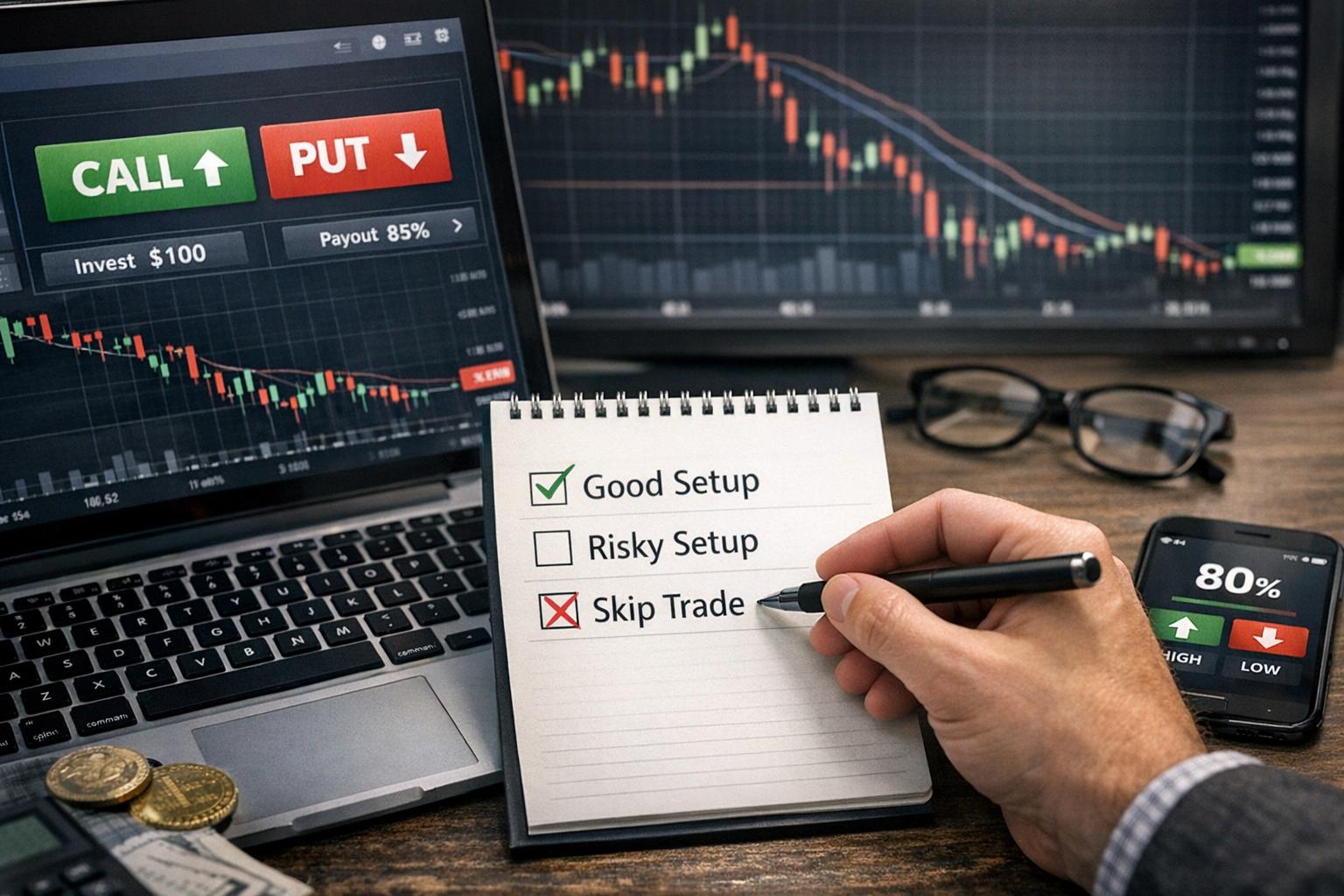
Binary Options Trade Filtering: When to Skip a Setup
Understanding Binary Options Trade Filtering
Binary options trading is structured around a simple premise: predicting whether the price of an asset will be above or below a specific level at a predetermined expiration time. Despite this structural simplicity, consistent profitability depends on disciplined decision-making. Many beginners assume that success comes from identifying strong entry signals alone. In practice, long-term stability in binary options often depends more on the ability to filter out weak or uncertain setups than on the ability to find trades.
Trade filtering is the process of applying predefined criteria to determine whether a setup meets established quality standards. Instead of reacting to every potential signal generated by indicators or price movement, a trader waits for alignment between multiple conditions. This structured restraint reduces exposure to low-probability trades and supports strategic consistency.
The Core Concept of Trade Filtering
At its foundation, trade filtering is about decision control. The financial markets continuously generate price fluctuations, patterns, breakouts, and pullbacks. Without filtering criteria, a trader may feel compelled to participate frequently. However, frequent engagement does not necessarily translate into improved results. In binary options, where the payout is typically fixed and the downside risk can equal or exceed the potential reward, avoiding marginal trades becomes particularly important.
Binary options differ from other trading formats because the payoff structure is predefined. A trader does not benefit from extended market moves beyond the expiration level. This means precision in timing and directional bias is critical. A trade entered under uncertain conditions has little opportunity to recover once placed. Filtering ensures trades are selected only when probability, timing, and conditions align.
Filtering criteria are most effective when standardized. Emotional decisions, impulse trading, or revenge trades often arise when traders deviate from their established rules. By defining acceptable and unacceptable conditions in advance, decision-making becomes systematic rather than reactive.
Market Structure and Context
Before applying technical indicators, traders must evaluate the broader market structure. Filtering begins with understanding whether the market is trending, consolidating, or transitioning between phases. Each structure influences how price behaves relative to expiration timing.
In trending markets, price tends to form higher highs and higher lows in an uptrend, or lower highs and lower lows in a downtrend. Binary options traders often look for pullbacks within established trends rather than attempting to capture reversals. Trades taken in alignment with the dominant trend typically offer higher probability because momentum supports the directional bias.
In contrast, ranging markets move between defined support and resistance levels. Expiry-based trading within ranges requires shorter timeframes and precise identification of boundaries. Entering trades in the middle of a range increases uncertainty. A filtering rule might restrict entries to areas near clear structural levels.
Market transitions present additional complexity. When a strong trend begins to weaken, volatility may increase while direction becomes less clear. Filtering conditions may dictate avoiding trades during these transitional phases because probability decreases.
Key Factors to Consider
Market Conditions and Volatility
Volatility plays a central role in trade filtering. In binary options, both insufficient and excessive volatility can reduce probability. Low volatility environments may produce narrow price movements, making it difficult for price to reach the projected level before expiration. Conversely, sudden volatility spikes can lead to erratic movements that invalidate technical signals.
Traders often measure volatility using statistical tools such as average true range or volatility bands. A filtering rule might allow trades only when volatility exceeds a minimum threshold but remains below extreme levels. This controlled volatility environment supports predictable price development within the chosen expiry window.
Liquidity is another aspect of market conditions. Instruments with thin liquidity may show irregular price gaps or inconsistent spreads. Filtering may involve limiting trading to major currency pairs, indices, or commodities during their most active sessions.
Timeframe Analysis and Expiration Alignment
Binary options trading is uniquely sensitive to timing. The same directional forecast may produce different results depending on expiration length. Filtering must align analysis timeframe with expiration selection.
Short-term expirations, such as one to five minutes, require clear, immediate momentum. Traders filtering for short-term trades may look for strong impulse candles, volume spikes, or breakout confirmations. If price action lacks momentum, the setup may be rejected.
Longer expirations, such as thirty minutes or more, require broader trend alignment. A filtering approach might avoid placing longer-duration trades against higher timeframe structure. Multi-timeframe analysis allows traders to confirm that short-term signals align with broader directional forces.
A mismatch between technical analysis timeframe and expiration period is a frequent source of losses. Therefore, structured filtering ensures that entry timing and forecast horizon are coherent.
News and Economic Data
Scheduled economic announcements can sharply affect market behavior. Central bank decisions, employment reports, inflation data, and geopolitical developments often trigger unpredictable reactions. Even when directional expectations appear logical, initial market responses can be volatile and inconsistent.
Many traders incorporate a rule that prohibits new trades within a defined window before and after major economic releases. This buffer reduces exposure to erratic behavior that may invalidate technical setups. Filtering based on event calendars is particularly important for currency-related binary options.
Beyond major reports, broader geopolitical developments also influence sentiment and drive unexpected volatility. Structured awareness of the economic environment contributes to disciplined filtering.
Indicator Alignment and Technical Confirmation
Technical indicators are widely used in binary options trading. Moving averages, oscillators, support and resistance levels, and pattern recognition all contribute to decision-making. However, reliance on a single indicator increases vulnerability to false signals.
Trade filtering often requires confluence. Confluence occurs when multiple independent indicators suggest the same directional bias. For example, a trader may require that price align with a moving average trend, reach a support or resistance level, and display confirming candlestick behavior before entering.
Conflicting Signals as a Red Flag
One of the primary red flags in binary options trading is indicator disagreement. If momentum oscillators show overbought conditions while price breaks above resistance, or if higher timeframes trend upward while lower timeframes trend downward, probability becomes uncertain.
Filtering rules may explicitly prohibit trades when signals conflict. Instead of attempting to interpret ambiguity, disciplined traders wait for clearer alignment. Patience becomes part of the strategy. Reduced trade frequency often improves overall results because each selected setup meets higher probability standards.
Avoiding Over-Optimization
While filtering improves trade quality, excessive criteria may create other challenges. Over-optimization occurs when traders continuously add new rules in an attempt to eliminate all losses. Because financial markets contain inherent randomness, no filtering system can provide perfect accuracy.
Effective filtering balances simplicity with consistency. A small number of well-tested criteria applied consistently is often more reliable than complex rule structures subject to constant adjustment.
Risk Management Considerations
Binary options include predefined risk and reward parameters. Many platforms offer payouts below 100 percent of the invested amount, meaning the trader must achieve a win rate greater than 50 percent to remain profitable. This payout structure makes filtering essential.
Poor Risk-Reward Ratio
If the potential payoff does not justify the probability of success, a trade may not be worthwhile. For example, with a payout of 70 percent, a trader must maintain a win rate well above half of all trades. Filtering should therefore emphasize setups with historically above-average performance.
Although traditional stop-loss methods do not apply in the same way as other trading instruments, capital allocation remains important. A filtering framework may include rules limiting position size relative to total account balance. Controlled exposure ensures that short-term losses do not significantly impair long-term capability.
Losing Streak Management
Even high-quality filtering systems encounter losing streaks. Variance is inherent in probability-based trading. A structured approach may include temporary pauses after a set number of consecutive losses. This pause allows objective reassessment and prevents emotionally driven decisions.
Filtering, therefore, is not limited to entry criteria. It also governs when not to trade due to performance patterns or reduced concentration.
Psychological Aspects of Trade Filtering
Psychological discipline reinforces technical filtering. Without emotional control, predefined criteria are often ignored. Common cognitive biases affect trade selection.
Overconfidence can lead traders to believe they can interpret ambiguous setups successfully. Fear of missing out may prompt premature entries before confirmation. Recency bias may influence decision-making after a string of wins or losses.
A structured written plan mitigates these tendencies. When traders document their filtering rules and review performance regularly, adherence improves. Objective records reveal whether skipped trades and executed trades align with established rules.
Session Selection and Timing Discipline
Financial markets operate in sessions characterized by varying liquidity and volatility. Major currency pairs behave differently during the Asian, European, and North American sessions. Filtering can involve restricting activity to periods when chosen instruments demonstrate reliable movement.
For instance, a currency pair involving the euro may show increased activity during the European session. Filtering trades outside this period may reduce exposure to unpredictable or stagnant phases.
Time-of-day analysis also reveals patterns in volume and volatility. Some traders observe that specific strategies perform better during opening hours of major exchanges. Filtering decisions based on session characteristics contribute to consistent execution.
Backtesting and Data Analysis
Reliable filtering criteria should be supported by historical evaluation. Backtesting involves applying rules to past market data to estimate potential performance. Although historical performance does not guarantee future outcomes, systematic testing identifies whether filtering adds measurable value.
When backtesting binary options strategies, traders must simulate realistic payout structures, expiration timings, and rule conditions. This process highlights weaknesses in filtering logic and prevents reliance on subjective impressions.
Forward testing in a simulated or small-scale live account further validates whether filtering rules remain effective under real-time conditions. Continuous performance tracking supports incremental refinement without constant structural changes.
Adapting to Market Evolution
Markets evolve due to technological developments, policy shifts, and changing participant behavior. Filtering systems must remain adaptable. Rigid adherence to outdated criteria may reduce effectiveness over time.
Adaptation, however, should follow data rather than reactive emotion. Periodic performance reviews allow traders to examine whether win rates decline across certain instruments or sessions. Adjustments based on statistical evaluation preserve strategic integrity.
Common Mistakes in Trade Filtering
Many traders misinterpret filtering as a method to remove all losing trades. Attempting to achieve perfect accuracy often leads to overcomplicated systems or frequent rule changes. Effective filtering instead focuses on enhancing average trade quality.
Another mistake involves inconsistent rule application. Skipping rules during favorable market phases undermines validity. If a system shows strong results only when certain criteria are met, ignoring those criteria introduces unnecessary variability.
Finally, some traders apply filtering selectively based on intuition. Consistency requires that every trade meet the same standards without exception.
Developing a Personalized Filtering Framework
No single filtering method suits all traders. Individual risk tolerance, availability, and psychological preferences influence strategy design. A trader preferring lower frequency with higher confidence may use stricter filtering, while another comfortable with moderate frequency may require fewer confirmations.
Development begins with defining a primary strategy. Once entry logic is clear, filtering layers are added to remove weaker variations of that setup. Documentation, measurement, and review guide refinement.
Effective frameworks specify acceptable market conditions, confirmation indicators, expiration alignment, risk parameters, and times to avoid trading. Clear structure reduces ambiguity and supports disciplined execution.
Conclusion
Binary options trading demands precision in both direction and timing. Because payouts are fixed and risk per trade is predefined, maintaining a high probability of success is essential. Trade filtering serves as a structured method for selecting only those setups that meet established criteria.
By evaluating market structure, volatility levels, timeframe alignment, economic conditions, and technical confluence, traders reduce exposure to low-probability situations. Red flags such as conflicting signals, unfavorable payout ratios, or irregular volatility further guide decisions to abstain.
Filtering does not eliminate losses, nor does it create certainty. Instead, it refines decision-making by increasing consistency and reducing impulse-driven actions. Over time, disciplined filtering supports stable performance, preserves capital, and enhances long-term sustainability in binary options trading.
This article was last updated on: April 30, 2026