
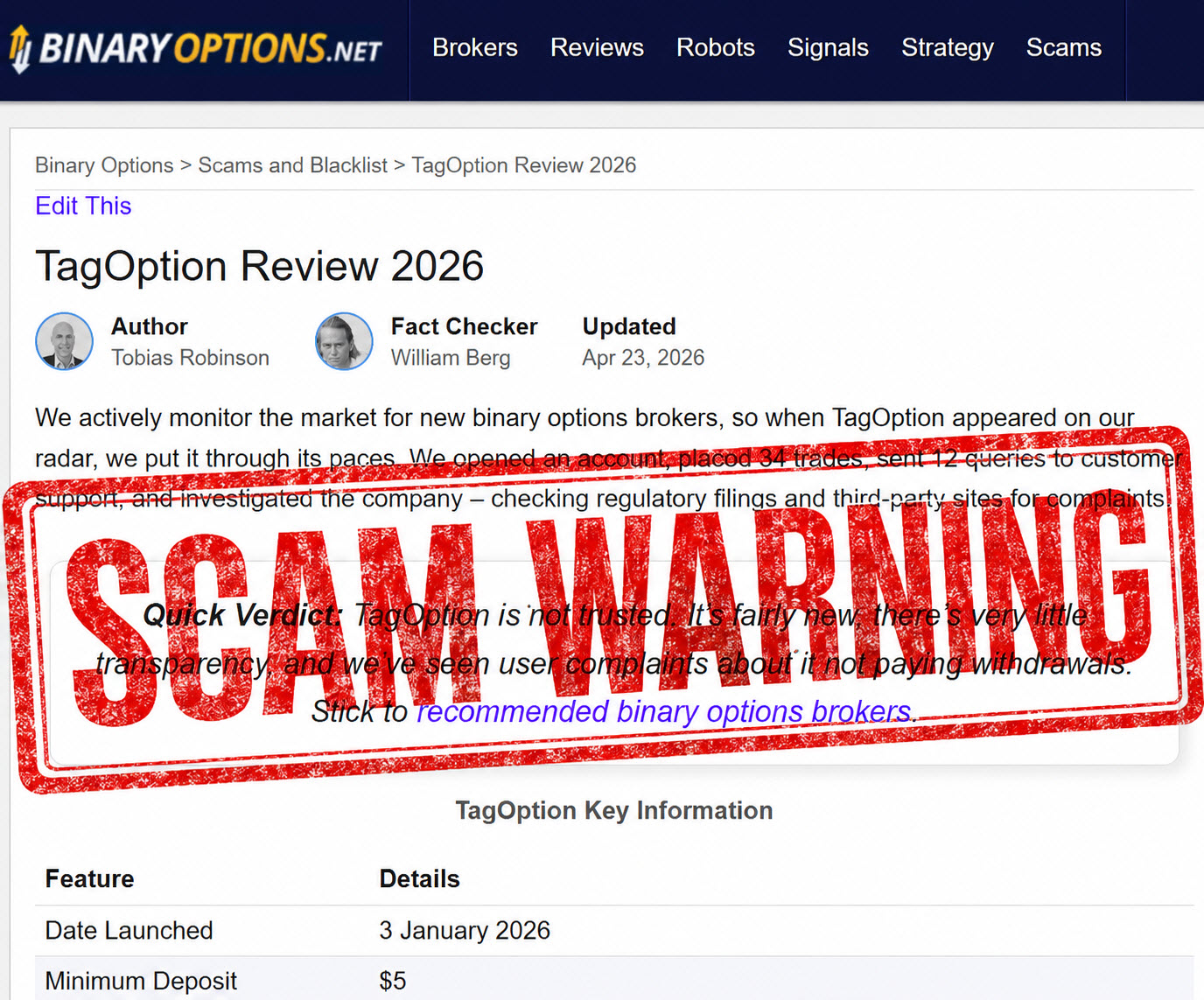
BinaryOptions.net flags TagOption as unsafe
BinaryOptions.net has issued a warning against TagOption after testing the broker and concluding that traders should avoid it. The full review is available through the link above, while its wider broker reviews, education pages, and binary options resources are available through the BinaryOptions.net home page.
The warning followed a hands on review. BinaryOptions.net says it opened an account, placed 34 trades, sent 12 customer support queries, checked regulatory filings, and searched third party websites for complaints. After that process, its verdict was simple: TagOption is not trusted.
According to the review, TagOption is a new binary options broker with very little transparency. The platform launched on January 3, 2026, offers a $5 minimum deposit, and allows trades from $0.10. Payment methods include M Pesa, Visa and Mastercard debit or credit cards, and USDT through the TRC20 network. The maximum payout advertised is 95%, while the platform showed 11 volatility binaries during testing, despite claims of more than 100 available assets.
BinaryOptions.net says the broker provides no clear company name beyond the TagOption brand, no physical office address, no licence number, no registered office, and no telephone support number. It also says customer support failed to answer direct questions about who operates the platform and where it is based. For traders, that is the core issue. A trading site can look usable, but if the company behind it cannot be identified, the user has no clear counterparty and no obvious route for complaints.
Main reasons behind the warning
The first concern is ownership. BinaryOptions.net says it searched TagOption’s website and client area but found no useful details about the broker’s legal entity or location. When it asked live chat for that information, support gave vague responses and did not provide the requested details. That is a serious warning sign because traders should know exactly who is holding their money before they deposit.
The second concern is regulation. BinaryOptions.net says it could not find TagOption on any regulatory database it checked. The review says those checks included major financial regulators and offshore jurisdictions where some binary options brokers are registered, including Saint Vincent and the Grenadines, the Seychelles, and Belize. Support staff also failed to provide regulatory details when asked. In practice, BinaryOptions.net says it had to assume TagOption is unregulated.
That matters because binary options disputes can become difficult very quickly. If a platform blocks withdrawals, changes terms, or refuses to answer complaints, the trader needs to know which authority can intervene. With an unregulated or unidentified broker, that safety layer may not exist. At that point, the customer is relying on the goodwill of the same platform holding the funds. That is not much of a plan.
The third concern is marketing. BinaryOptions.net says TagOption claimed during sign up to have “1M+ traders.” The review questioned that claim because the website was only registered in January 2026 and had little third party review history. Trustpilot reportedly showed just two reviews, both described as scam complaints. BinaryOptions.net does not prove the user number is false, but says it appears very unlikely.
The fourth concern is the trading platform itself. BinaryOptions.net says it spent hours testing TagOption and found that parts of the charting package did not work. Attempts to change the chart type or add technical indicators reportedly did nothing, even after refreshing pages, switching browsers, and testing on different days. For casual users this may seem minor. For active traders, it is not. Binary options often depend on short term decisions, and a platform with broken analysis tools is not a useful place to make those decisions.
The fifth concern is the product range. BinaryOptions.net says TagOption advertised more than 100 assets during sign up, but only 11 volatility based binary products appeared in the platform. The review suggested these may be broker built instruments designed to mimic market volatility without tracking a clear underlying financial market. That raises an obvious question: what exactly is the trader pricing, and who controls the outcome mechanics?
Withdrawal complaints complete the warning. BinaryOptions.net says it saw user complaints about withdrawal freezes and unpaid withdrawals. In online trading, that is one of the hardest red flags to ignore. Deposits are usually easy because the platform wants funds in. The real test is whether money comes back out when the customer asks.
Why TagOption raises wider concerns for binary traders
Binary options are simple to understand but difficult to trade well. The trader usually chooses whether a condition will be met by expiry. If correct, the payout is fixed. If wrong, the stake is lost. That clean structure is part of the appeal. It is also part of the danger, because a simple order ticket can make a high risk product feel almost harmless.
BinaryOptions.net’s wider site explains that binary options have fixed yes or no outcomes and that some contracts can expire in seconds. It also warns that the sector has been damaged by scams and poor operators. That background matters when reading the TagOption warning. Traders are not only judging a product. They are judging the platform that creates access to that product.
TagOption’s volatility binaries deserve particular caution because BinaryOptions.net says they may be broker built rather than linked to conventional underlying markets. If the asset is not clearly tied to an independent market, traders have less ability to assess price movement, compare data, or challenge outcomes. The platform becomes both the venue and, effectively, the source of the market. That is a lot of trust to place in a broker that does not clearly disclose who runs it.
This does not mean every binary platform is automatically unsafe. It does mean the burden of proof should be high. If a broker lacks clear ownership, clear regulation, working tools, a credible asset list, and a clean withdrawal record, traders do not need to wait for one final dramatic clue. The pattern is enough.
How to check a broker before depositing
The first step is to identify the legal company behind the trading brand. A name on a homepage is not enough. Traders should look for the operating company, registration number, registered address, regulator, licence number, and complaint process. These details should be easy to find before sign up. If support cannot provide them clearly, there is no good reason to deposit first and investigate later.
The second step is to verify regulation through official databases. Do not rely on badges, screenshots, PDFs, or links supplied by the broker. Go directly to the regulator’s website and search for the exact legal entity. Check whether the firm is authorised for the activity being offered. A company may be registered somewhere for general business purposes but still not be licensed to provide trading services to retail clients.
The third step is to match the details. The company name, domain, email address, phone number, payment recipient, and licence entry should line up. Clone firms and weak operators often rely on partial checks. A trader finds a similar name, sees a registration number, and assumes the rest is fine. It is not. If the official record shows one website but the broker uses another, stop.
The fourth step is to inspect the payment route. If the platform accepts card payments, mobile money, or crypto, check who actually receives the funds. Convenience is not protection. Crypto payments are especially difficult to reverse once sent. If a broker pushes USDT or another crypto method while hiding its legal identity, that is not a nice modern payment option. It is a risk transfer from the platform to the customer.
The fifth step is to read the withdrawal rules before depositing. Look for withdrawal fees, minimum withdrawal limits, account verification conditions, bonus turnover rules, dispute clauses, and broad rights to freeze accounts. Many traders focus on payout percentages and trade size. That is understandable, but incomplete. The exit terms matter more than the entry button.
A small deposit can reduce the damage if something goes wrong, but it does not prove safety. Some unsafe platforms allow small withdrawals at first to build confidence. Still, testing a small withdrawal before increasing exposure is sensible. A platform that cannot process a basic withdrawal under its own terms should not be trusted with a larger account balance.
Traders should also save records from the beginning. Keep screenshots of the account area, asset list, terms, deposit confirmation, chat conversations, emails, trade history, and withdrawal requests. Evidence collected early is cleaner than evidence gathered later after pages change or support chats disappear.
What to do if funds are stuck
If a platform delays or blocks withdrawals, stop sending money immediately. Do not pay extra release fees, tax deposits, wallet unlocking charges, or verification payments unless the demand is independently confirmed through a trusted official source. These requests often appear when a scam is trying to extract more money.
Preserve all evidence, including account screenshots, withdrawal requests, chat logs, emails, transaction receipts, wallet addresses, and the terms that applied when the account was opened. Then contact the bank, card issuer, mobile money provider, crypto exchange, or wallet provider used to fund the account and ask what dispute or fraud options are available.
Suspected scams should also be reported to the relevant financial regulator or consumer protection agency in the trader’s jurisdiction. Be careful with recovery firms that appear after the loss and promise to retrieve funds for an upfront fee. Many are just a second scam. Same wound, cleaner invoice.
This article was last updated on: May 20, 2026