
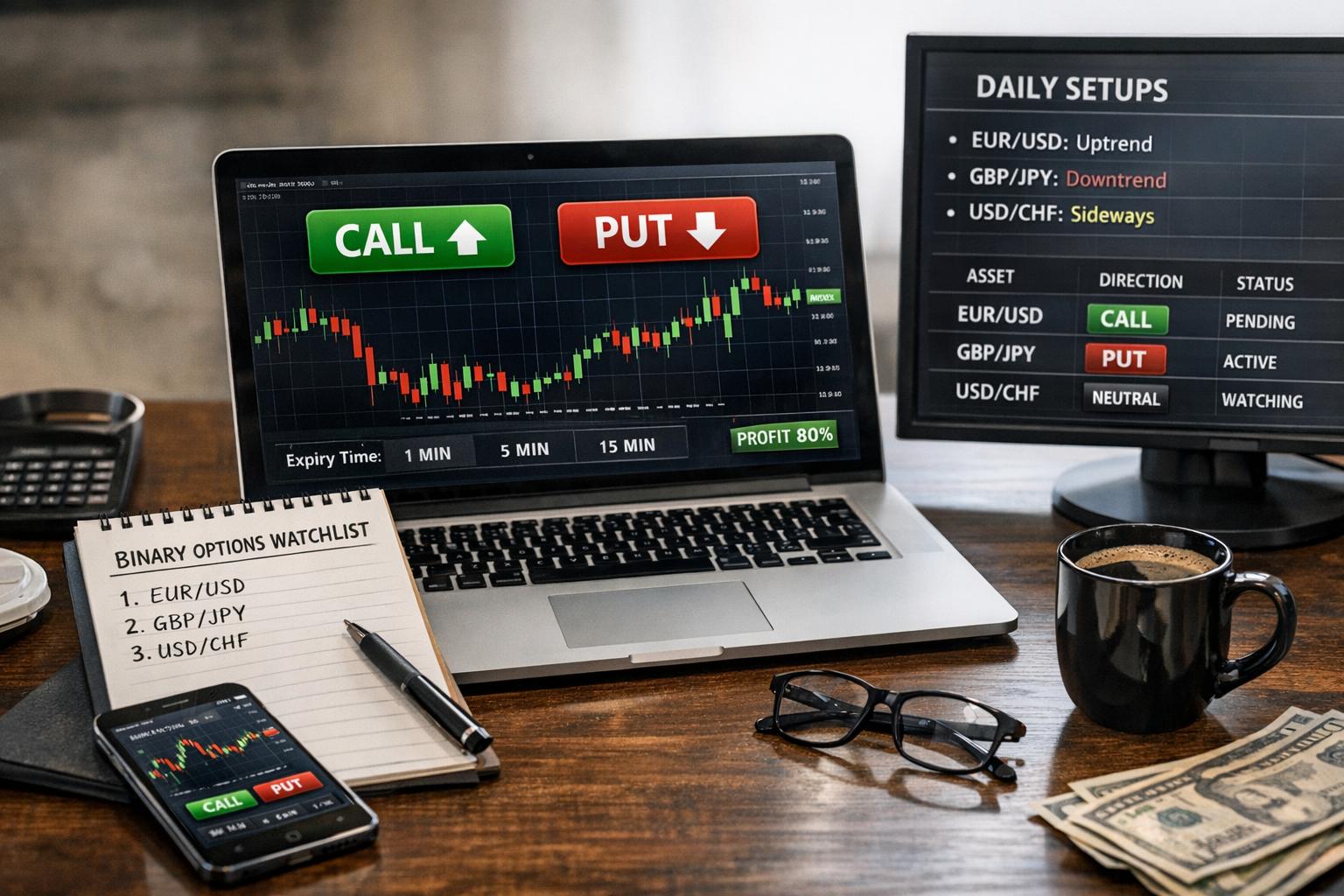
How to Create a Binary Options Watchlist for Daily Setups
Introduction to Binary Options Watchlist
Creating a binary options watchlist is a structured method that enables traders to approach the market with clarity and consistency. In binary options trading, where outcomes are determined within predetermined time frames, preparation plays a critical role. A watchlist serves as a focused collection of assets that a trader monitors regularly in search of favorable trading conditions. Instead of scanning dozens or hundreds of instruments randomly, the trader concentrates only on those that meet predefined strategic requirements.
Binary options contracts typically involve predicting whether the price of an asset will be above or below a specific level at expiration. Because trade durations can range from minutes to hours or longer, timing and precision are essential. A watchlist supports this need by narrowing the trader’s attention to selected markets that exhibit measurable characteristics aligned with their trading method. By doing so, it enhances efficiency, promotes systematic analysis, and supports disciplined execution.
Understanding the Purpose
The primary purpose of a binary options watchlist is to create structure within the trading process. Without a defined group of assets to monitor, traders may react impulsively to sudden market movements or shifts in volatility. A watchlist reduces this randomness by directing attention to instruments that have already been evaluated according to specific criteria.
A watchlist also serves as an analytical framework. When assets are chosen intentionally, traders can study their behavior over time, observing recurring patterns, volatility ranges, reaction to economic news, and typical trading hours. This repetitive observation builds familiarity, and familiarity can improve the speed and quality of trading decisions.
Another significant purpose of a watchlist is time management. Binary options trading often involves short expiration periods, meaning traders must act quickly when opportunities arise. If a trader is continuously searching for suitable instruments, valuable time may be lost. A prepared watchlist ensures that potential setups are identified more efficiently, allowing traders to allocate more time to analysis and execution rather than asset discovery.
Furthermore, a watchlist can reinforce consistency. Traders who operate without structured asset selection may frequently shift between instruments without understanding their underlying dynamics. A defined list encourages consistency by promoting repeated engagement with the same markets. Over time, this repetition can lead to deeper insight into price tendencies and behavioral patterns.
Steps to Create a Binary Options Watchlist
1. Define Trading Criteria
The foundation of any effective watchlist is clearly defined trading criteria. Before selecting assets, traders must determine how they intend to participate in the market. This includes identifying their preferred expiration times, acceptable risk levels, and analytical approaches. Some traders may rely heavily on technical analysis, focusing on indicators, support and resistance zones, and trend structures. Others may incorporate fundamental analysis, monitoring economic data releases and corporate announcements.
Defining criteria also involves clarifying volatility preferences. Certain binary options strategies benefit from highly volatile markets where price movements are fast and pronounced. Other approaches may perform better in stable or range-bound environments. If a trader prefers rapid price fluctuations for short-term contracts, assets with historically high volatility may be prioritized. Conversely, if stability is valued, more moderate markets may be selected.
Risk tolerance is another essential factor. Some traders aim for frequent, smaller positions, while others prefer fewer trades with potentially larger exposure. The asset selection process should align with this risk structure. For example, highly unpredictable markets may not suit conservative strategies.
Time availability also influences criteria. Traders operating during specific trading sessions should select assets that exhibit active price movement during those periods. Currency pairs, equities, and commodities each have peak trading hours. Aligning asset choice with personal schedules increases the likelihood of analyzing active, liquid markets.
By outlining these elements in advance, traders establish a logical filter through which potential watchlist candidates are evaluated. This process ensures that asset selection is intentional rather than arbitrary.
2. Select the Assets
After defining trading criteria, the next step is selecting assets that meet these requirements. Binary options platforms commonly offer a range of instruments, including currency pairs, stocks, commodities, and indices. Each asset class presents distinct behavior patterns and influences.
Currency pairs are often chosen because of their liquidity and predictable reaction to macroeconomic news. Major pairs typically exhibit consistent spreads and reliable volatility during global market sessions. For traders focusing on short-term binary contracts, this liquidity can be advantageous, as price movements tend to respond quickly to economic signals.
Stocks may be included if the trader has familiarity with specific companies or sectors. Corporate earnings reports, industry developments, and economic trends can influence stock prices in measurable ways. Selecting a limited group of stocks allows a trader to follow company-specific events that may generate predictable price responses.
Commodities such as gold, oil, or agricultural products are affected by supply-demand dynamics, geopolitical events, and seasonal trends. Traders who understand these drivers may incorporate certain commodities into their watchlists. Indices represent broader market segments and can reflect overall economic health or sector performance.
It is generally advisable to start with a manageable number of assets rather than attempting to monitor too many simultaneously. A smaller, focused watchlist enhances depth of analysis and reduces the risk of oversight. Over time, as familiarity increases, the list may be expanded or adjusted.
Asset selection should also consider historical behavior. Reviewing past volatility, daily trading ranges, and responsiveness to technical patterns can help determine suitability. Instruments that consistently exhibit erratic or unpredictable movements may not align with structured binary strategies.
3. Analyze Market Trends
Once potential assets are selected, systematic analysis is required. Monitoring recent and historical market trends allows traders to evaluate whether an asset currently aligns with their strategy. Trend analysis may involve identifying sustained upward or downward movements, range-bound conditions, or transitional phases.
Technical indicators can support this evaluation. Moving averages may reveal overall direction, while oscillators such as the Relative Strength Index can indicate overbought or oversold conditions. Chart patterns, including channels, triangles, or breakouts, provide additional context. Since binary options involve predicting direction within a fixed period, clarity of trend is particularly important.
Fundamental influences should also be considered. Economic calendars provide schedules of upcoming data releases, such as interest rate decisions or employment reports. Assets that are expected to experience significant news-driven volatility may be either prioritized or temporarily excluded depending on the trader’s comfort with rapid price movements.
Market sentiment analysis is another component. Broader market conditions, such as risk-on or risk-off environments, can influence asset correlation. For example, during periods of economic uncertainty, certain safe-haven assets may strengthen while risk-sensitive markets decline. Understanding these relationships can refine watchlist monitoring.
The goal of trend analysis is not to predict all future movements but to identify contexts where probability appears aligned with the trader’s chosen method. By combining systematic review with predefined criteria, traders transform their watchlist from a static list of symbols into an active analytical workspace.
4. Organize the Watchlist
Organization plays a practical role in watchlist effectiveness. A disorganized collection of assets can lead to confusion, delayed decisions, and overlooked opportunities. Structured categorization enhances clarity and workflow.
Assets may be grouped by class, such as currencies, stocks, commodities, and indices. Within each group, further segmentation can be based on volatility levels, geographic region, or average trading range. Such categorization simplifies rapid scanning during active trading sessions.
Trading platforms typically allow customization, enabling traders to rearrange instruments and add notes. Supplemental tools, such as spreadsheets or digital journals, can be used to record observations about each asset. Notes might include recent performance characteristics, significant price levels, or recurring behavioral tendencies.
Color-coding or tagging systems can also improve organization. For instance, assets that currently align strongly with trading criteria can be marked differently from those under observation but not yet ideal. This visual differentiation supports efficient prioritization during analysis.
Consistency in organization is essential. Updating asset placements or notes should follow a standardized routine, ensuring that the watchlist remains practical rather than cluttered.
Benefits of a Comprehensive Watchlist
A comprehensive watchlist supports several operational advantages. One of the most significant benefits is improved discipline. By focusing only on preselected assets, traders reduce exposure to impulsive decisions driven by sudden market fluctuations outside their strategic scope. Discipline contributes to consistency, and consistency enables clearer evaluation of performance.
Risk management also improves with a structured watchlist. When assets are chosen carefully based on volatility, liquidity, and predictability, traders are better equipped to assess potential outcomes within their defined risk parameters. Random asset selection can introduce unforeseen variability, while planned monitoring supports more stable execution.
Efficiency is another practical advantage. Rather than scanning entire markets continuously, traders direct attention to a manageable set of opportunities. This focused approach reduces cognitive overload and supports faster interpretation of price movements when time-sensitive binary contracts are involved.
A watchlist also fosters analytical depth. Repeated observation of the same assets builds contextual knowledge. Traders may learn how specific currency pairs respond during particular trading hours, how certain stocks react to earnings expectations, or how commodities respond to macroeconomic changes. This familiarity enhances pattern recognition and may support more informed decisions.
Performance evaluation benefits as well. When traders confine their activity to defined instruments, reviewing past trades becomes more meaningful. Patterns of success or error can be traced to specific assets, time frames, or strategy applications. Without a structured watchlist, trade records may appear inconsistent or scattered, making analysis more difficult.
Constant Review and Updates
An effective watchlist is not static. Financial markets evolve in response to economic developments, monetary policy shifts, geopolitical changes, and structural trends. Assets that once aligned with a given strategy may change characteristics over time. Regular review ensures that the watchlist remains relevant.
Periodic evaluation might involve examining volatility metrics, average ranges, or changes in liquidity. Assets exhibiting prolonged inactivity may be replaced with more dynamic alternatives. Conversely, markets experiencing excessive unpredictability may be temporarily removed if they no longer fit predefined criteria.
Strategic adjustments also affect watchlist composition. If a trader modifies their approach—perhaps shifting from short-term expirations to longer-duration contracts—the asset selection may require revision. Instruments suitable for rapid movements may not suit extended time frames.
Schedule-based reviews can increase consistency. Some traders perform weekly or monthly assessments, examining performance logs and market conditions. This structured review process transforms the watchlist into a living document that evolves with experience and strategy refinement.
Documentation during updates is valuable. Recording reasons for adding or removing assets provides historical perspective and supports decision transparency. Over time, this record can reveal patterns in asset performance and strategic alignment.
Integrating Technology and Analytical Tools
Modern trading environments provide numerous technological tools that can enhance watchlist functionality. Alerts can be configured to notify traders when an asset reaches a predetermined price level or indicator threshold. Such automation reduces the need for constant screen monitoring while preserving responsiveness.
Charting software often allows simultaneous display of multiple instruments, facilitating comparison. Multi-chart layouts enable traders to observe correlations and relative strength within their watchlist. This comparative view can provide context for directional decisions in binary contracts.
Analytical tools, including volatility scanners and economic calendars, can be integrated into watchlist management. These resources help traders anticipate periods of heightened activity or potential consolidation. When probability-based setups are aligned with both technical and fundamental indicators, the watchlist becomes a dynamic research platform rather than a static symbol directory.
Care should be taken, however, to avoid excessive complexity. While technology enhances analytical capacity, maintaining clarity remains essential. Overloading the watchlist environment with numerous indicators or notifications can dilute focus. The objective is to streamline decision-making, not complicate it.
Common Challenges and Considerations
Despite its advantages, constructing and maintaining a watchlist presents challenges. One common issue is expansion beyond manageable limits. Traders may continuously add new assets in response to emerging market trends, eventually creating a list too large to monitor effectively. Regular pruning mitigates this risk.
Another challenge involves emotional bias. Traders may retain assets due to personal familiarity rather than strategic alignment. Decisions regarding inclusion should be guided by measurable criteria rather than preference.
Market conditions can also shift rapidly. Unexpected geopolitical events or economic shocks can temporarily distort asset behavior. During such periods, traders may need to pause and reassess watchlist relevance rather than relying solely on historical analysis.
Maintaining balance is important. A watchlist should be detailed enough to provide structured guidance yet flexible enough to accommodate market evolution. Achieving this balance requires periodic reflection and disciplined application of original criteria.
Conclusion
A binary options watchlist functions as a structured framework that supports focused, disciplined trading. By defining clear criteria, selecting appropriate assets, analyzing market trends, and organizing information effectively, traders create an environment conducive to systematic decision-making. The watchlist enhances operational efficiency, strengthens risk awareness, and promotes consistency in execution.
Regular review ensures continued alignment with evolving market dynamics and strategic objectives. When managed thoughtfully, a watchlist becomes more than a simple collection of instruments; it serves as an analytical foundation that underpins the entire trading process. Through deliberate construction and ongoing refinement, traders can use this tool to approach binary options markets with greater structure and clarity.
This article was last updated on: June 2, 2026