
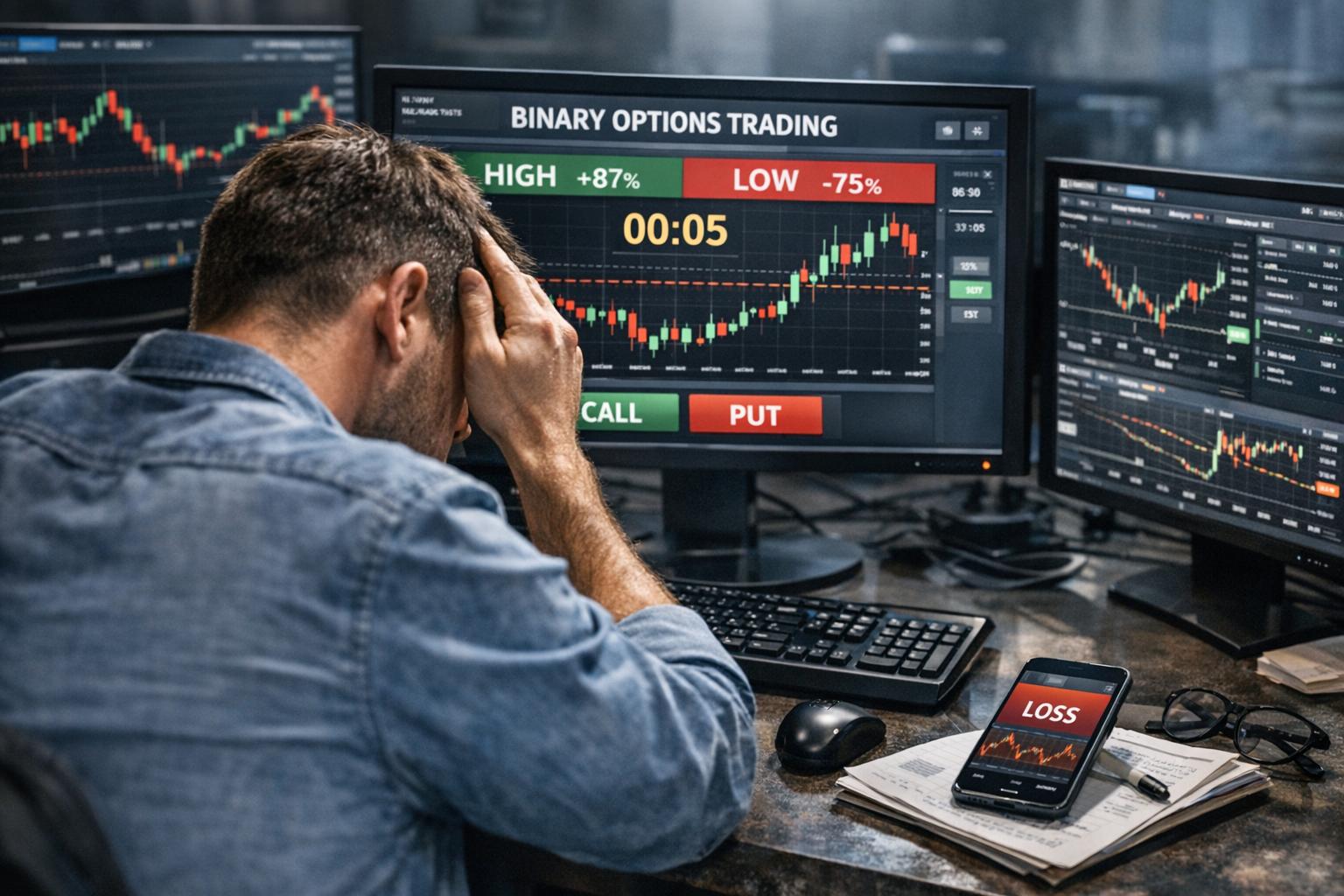
How to Avoid Overtrading in Fast Binary Options Markets
Understanding Overtrading in Fast Binary Options Markets
In the world of binary options trading, particularly within fast-paced market environments, overtrading is a frequent and structurally significant risk. Binary options are characterized by fixed payouts and predefined expiration times, often ranging from seconds to hours. In fast markets, where price movements occur rapidly and trading opportunities appear continuously, decision-making speed increases while analytical depth may decrease. This environment can encourage traders to enter positions more frequently than their strategy justifies. Over time, this pattern can undermine consistency, distort risk management, and erode account capital.
Overtrading is not defined solely by the number of trades executed within a given period. Instead, it refers to trading activity that exceeds the boundaries of a well-constructed plan. A trader may execute a high number of trades within a disciplined framework and maintain positive expectancy. Conversely, a trader may place relatively few trades but still engage in overtrading if those positions are impulsive, inadequately analyzed, or inconsistent with predefined criteria. In fast binary options markets, the compressed timeframes amplify these risks. Short expiration contracts intensify the feedback cycle between action and result, making it easier for behavioral impulses to influence judgment.
Understanding how fast markets alter trader psychology, perception of opportunity, and perceptions of risk is central to preventing overtrading. Speed does not merely increase the number of available setups; it magnifies pressure, reduces reflective analysis time, and often gives the impression that capital must be continuously deployed. Without structural controls, traders may confuse activity with productivity.
Market Structure and Speed in Binary Options Trading
Binary options differ from traditional financial instruments in several structural ways. Each trade produces a predefined outcome: either a fixed return if the prediction is correct or a defined loss if it is not. This simplicity can create the illusion that each individual trade is independent and easily repeatable. In fast markets, where price action unfolds within minutes or seconds, traders may perceive an ongoing stream of discrete opportunities.
Shorter expiration times intensify the psychological pace of trading. A trader can complete multiple trade cycles within an hour, receiving rapid feedback after each result. This quick turnover can encourage compulsive reinvestment of profits or attempts to immediately recover losses. Moreover, because the payoff is fixed, traders may underestimate the cumulative impact of transaction frequency on expected returns.
Fast-moving currency pairs, commodities during major economic announcements, and volatile indices during periods of high liquidity are especially prone to overtrading conditions. In such contexts, volatility becomes both an opportunity and a source of distortion. Frequent price fluctuations can give the impression of predictable patterns even when movement is largely noise. Without disciplined filtering criteria, traders may interpret short-term fluctuations as meaningful signals.
Recognizing the Signs of Overtrading
The first step in addressing overtrading is recognizing when behavior deviates from strategy. In fast binary options markets, the boundary between planned activity and impulsive execution can become blurred. Several consistent indicators suggest that overtrading may be occurring.
One key sign is an increase in trade frequency that is not supported by additional analysis. If the number of trades expands without a corresponding increase in documented setups or strategy-confirmed conditions, this imbalance indicates reactive decision-making. Trades entered without a clear rationale, or those justified retroactively rather than prospectively, also signal overextension.
Another common indicator is deviation from predefined expiration times or asset selections. For example, a trader who typically specializes in five-minute expirations on major currency pairs may begin experimenting with one-minute contracts on unfamiliar assets after a series of losses or gains. Such deviation often reflects emotional adaptation rather than disciplined experimentation.
Behavioral cues also provide insight. Rapid entry after closing a losing trade, doubling position size to compensate for prior outcomes, or trading outside scheduled market review periods are observable patterns. In fast markets, the short gap between trades reduces the natural pause that might otherwise prevent escalation.
Emotional intensity is another marker. While trading should be approached analytically, overtrading often involves heightened responses to price movements. Traders may monitor charts continuously, interpret minor movements as urgent signals, or feel compelled to remain active despite limited setup validity. These experiences are structural consequences of compressed timeframes combined with insufficient procedural boundaries.
Psychological Drivers Behind Overtrading
Overtrading arises from identifiable psychological mechanisms. One common driver is recency bias, in which traders overweight the significance of recent outcomes. After a series of profitable trades, confidence may expand beyond rational calibration. The assumption that favorable conditions will persist can increase position frequency.
Conversely, loss-driven escalation plays a substantial role. In fast binary options trading, losses are realized quickly. The desire to restore account balance immediately can trigger additional entries without adequate signal confirmation. Because expiration times are short, the psychological temptation to correct performance within minutes is strong.
Another driver is illusion of control. Frequent engagement with charts may create the impression that close observation yields predictive power. In volatile markets, traders may feel that constant monitoring allows them to anticipate price direction with greater precision. This perception encourages continuous market participation rather than selective engagement.
Boredom or structured time pressure also contributes. Traders allocating fixed time blocks to trading sessions may feel compelled to act during that window. If valid setups are scarce, the pressure of limited time may lead to reduced selectivity. In fast markets, the abundance of price movement can be misinterpreted as abundance of quality opportunity.
Operational Indicators of Overtrading Behavior
Operational data often reveals overtrading more clearly than subjective introspection. A review of trading logs may show that average time between trades has decreased significantly. The ratio of planned setups to spontaneous entries may deteriorate. Win rates may remain relatively stable, but overall profitability declines due to increased exposure.
Another operational sign is inconsistent stake sizing. In a structured binary options plan, position sizing should align with a fixed percentage of capital. When traders vary stake amounts significantly, particularly in response to recent outcomes, they may be reacting emotionally rather than executing a defined risk model.
Shortened analysis periods also indicate excessive activity. If a trader previously required several minutes of confirmation across technical indicators but begins entering trades based on a single price movement, analytical discipline is eroding. Fast markets create urgency, but disciplined traders maintain consistent evaluation standards regardless of speed.
Consequences of Overtrading
Overtrading generates measurable financial, cognitive, and strategic consequences. These effects compound over time and can transform a marginally profitable system into an unviable approach.
Increased Transaction Exposure
Although binary options have fixed payout structures, each trade carries risk. When trade frequency increases, total capital exposure expands. Even if each individual trade risks a small percentage, executing a high number of trades within a short window amplifies the probability of encountering adverse sequences.
Transaction frequency also interacts with payout ratios. Since binary options often offer less than a one-to-one payout, consistent profitability requires maintaining a win rate above a specific threshold. As trade count increases, maintaining that threshold becomes statistically challenging if signal quality declines. Increased volume without increased edge leads to negative expectancy.
Cognitive Fatigue and Decision Degradation
Rapid decision cycles generate cognitive fatigue. Each trade requires assessment of trend direction, volatility, expiration timing, and risk allocation. In fast markets, these evaluations occur continuously. Over time, cognitive resources diminish, leading to simplified heuristics and reduced analytical depth.
Decision fatigue can result in inconsistent application of strategy rules. Traders may begin ignoring secondary confirmation indicators or neglecting market context. Reaction time may remain fast, but judgment quality declines. The combination of speed and fatigue often leads to misinterpretation of price patterns and impulsive entries.
Distortion of Performance Evaluation
Excessive trading muddies performance data. When large numbers of low-quality trades mix with high-quality setups, the resulting performance metrics become difficult to interpret. Traders may struggle to differentiate whether losses derive from flawed strategy parameters or execution inconsistency.
Furthermore, high-volume trading increases variance in short-term results. Even a strategy with positive expectancy can experience drawdowns amplified by dense clustering of trades. Without understanding the statistical implications, traders may misinterpret normal variance as system failure and further escalate activity in response.
Reinforcement of Impulse-Based Patterns
Repeated engagement in impulsive trading reinforces procedural shortcuts. Behavioral conditioning strengthens the association between market movement and immediate response. Over time, selective discipline becomes more difficult to maintain because rapid participation becomes habitual.
In fast binary options markets, habit formation occurs quickly due to the short feedback loop. Each outcome, whether positive or negative, reinforces neural patterns associated with action. Without deliberate interruption, the cycle becomes self-sustaining.
Strategies to Prevent Overtrading
Preventing overtrading requires structured mechanisms that operate independently of fluctuating emotions. In fast-paced environments, reliance on self-control alone is insufficient. Instead, traders benefit from predefined quantitative constraints and procedural clarity.
Developing a Robust Trading Plan
A well-defined trading plan functions as a regulatory framework. It establishes objective entry criteria, approved asset classes, expiration durations, and risk parameters. In fast binary options markets, specificity is especially important. Vague criteria such as “strong momentum” or “clear breakout” leave room for subjective interpretation under time pressure.
The plan should specify exact technical conditions required for entry. For example, alignment between trend indicators, confirmation from volume or volatility metrics, and market context analysis across multiple timeframes. Each condition reduces ambiguity and narrows the number of acceptable trades.
Capital allocation rules must also be explicitly defined. Fixed percentage risk per trade creates consistency. When traders commit to a predetermined stake size relative to account equity, deviations become easier to detect and correct.
Additionally, the trading plan can include maximum daily trade limits. Setting a cap on the total number of trades per session introduces an external boundary. Once the limit is reached, trading ceases regardless of market conditions. This structural constraint protects against reactive escalation.
Establishing Time-Based Controls
Fast markets often operate across multiple active sessions throughout the day. Limiting trading to predetermined intervals reduces impulsive engagement. For example, a trader may choose to operate only during periods of high liquidity, such as market overlaps, and abstain during transitional phases.
Scheduled review breaks are particularly important. Pausing after a defined number of trades allows cognitive reset. During this interval, traders can review executed positions and confirm alignment with strategy parameters. By introducing deliberate interruption, the momentum of overtrading is decreased.
Setting Realistic and Structured Performance Goals
Performance targets influence behavior. When traders set aggressive daily profit expectations, they may attempt to force results through increased activity. In binary options markets, where payout ratios require stable win rates, expecting consistent high returns over short intervals is structurally unrealistic.
Instead, traders can establish process-based goals rather than outcome-based targets. For example, adherence to entry criteria, maintenance of fixed risk percentages, and accurate documentation of trades. By focusing on execution quality, trade frequency naturally aligns with opportunity quality rather than desired profit magnitude.
Review periods should be sufficiently long to account for statistical variance. Evaluating results over several weeks rather than isolated sessions reduces the pressure to recover losses immediately. This broader perspective discourages short-term overextension.
Using Stop-Loss Principles and Exposure Limits
Although individual binary options trades have defined risk, overall account risk requires management. Daily loss limits function as circuit breakers. If cumulative losses reach a predefined percentage of capital within a session, trading activity stops automatically.
This rule prevents rapid drawdowns driven by sequential trades. In fast markets, several losing trades can occur within minutes. A cumulative loss boundary ensures that damage remains contained and that analysis can resume under stable conditions.
Take-profit targets can also serve as activity regulators. When reaching a predetermined profit threshold for the session, traders may conclude trading for the day. This practice prevents profit erosion through unnecessary continuation after satisfactory performance.
The Role of Education and Continuous Learning
Education plays a structural role in preventing overtrading by strengthening strategic clarity and risk awareness. Traders who understand statistical expectancy, payout ratios, and probability distribution are better equipped to resist the illusion that increased frequency improves outcomes.
Studying historical performance data helps clarify how many high-quality setups typically occur within a given session. When traders recognize that only a limited number of valid opportunities exist each day, they reduce the compulsion to participate continuously.
Simulation trading environments are particularly useful for refining discipline. Practicing adherence to strict entry rules without financial consequence allows traders to observe how often genuine setups arise. Over time, this calibration informs realistic expectations about trade frequency.
Ongoing learning should also include behavioral review. Maintaining a structured trading journal encourages self-awareness. Recording the rationale behind each trade, including emotional state and market context, creates an audit trail. Reviewing these records identifies recurring patterns of deviation that contribute to overtrading.
Adaptation to evolving market conditions is another element of continuous learning. Fast markets may shift volatility regimes over time. Rather than increasing trade count to compensate for reduced clarity, traders can adjust timeframe selection, indicator sensitivity, or asset focus within the boundaries of a revised plan.
Technology and Structural Safeguards
Modern trading platforms provide tools that can reduce overtrading risk when configured appropriately. Automated alerts based on predefined criteria allow traders to wait passively for qualified setups instead of scanning charts continuously. This reduces reactive decision-making.
Position size calculators ensure consistency with risk parameters. Some platforms allow daily loss limits to be preprogrammed, restricting further transactions once thresholds are reached. By shifting enforcement from subjective judgment to automated control, traders decrease reliance on fluctuating self-discipline.
However, automation should not replace understanding. Algorithmic or semi-automated tools must reflect thoroughly tested strategies. Without proper design, automation can simply accelerate overtrading rather than prevent it.
Long-Term Sustainability in Fast Binary Options Trading
Sustainable participation in fast binary options markets depends on preserving capital, cognitive clarity, and statistical edge. Overtrading threatens all three. High activity levels do not inherently produce profitability; rather, selective engagement aligned with structured criteria forms the foundation of consistent results.
The central principle is alignment between trade frequency and verified opportunity. When frequency exceeds opportunity, expectancy deteriorates. Traders must therefore establish independent constraints that define when not to trade as clearly as when to trade.
Periodic performance audits reinforce this discipline. Evaluating metrics such as average trades per day, win rate consistency, average return per trade, and deviation from plan parameters provides objective insight into behavior. If trade count rises while performance declines, corrective action becomes measurable rather than speculative.
Fast markets will continue to present continuous price movement. Not all movement constitutes a valid setup. Distinguishing between activity and opportunity is the core skill that separates disciplined practitioners from overextended participants.
Conclusion
Avoiding overtrading in fast binary options markets requires structured planning, quantitative boundaries, and consistent self-review. Rapid price action and short expiration cycles intensify decision pressure and compress feedback loops, increasing susceptibility to impulsive behavior. By recognizing operational and psychological indicators of excessive activity, traders can intervene before significant capital erosion occurs.
A comprehensive trading plan, realistic performance expectations, exposure limits, and scheduled analysis intervals serve as foundational controls. Continuous education, detailed journaling, and the strategic use of technology further reinforce disciplined participation. Over time, adherence to these principles supports stable execution and clearer performance evaluation.
In fast binary options environments, strategic selectivity is more sustainable than constant engagement. Structured limitation, rather than expanded activity, provides the framework for maintaining consistency within high-speed markets.
This article was last updated on: June 14, 2026