
Binary Options Range Trading Setups in Quiet Market Conditions
Understanding Binary Options Range Trading
Binary options range trading is a structured approach to speculative price forecasting in which the trader anticipates that an asset’s market price will remain within defined upper and lower boundaries during a predetermined time period. Unlike directional binary options strategies, where the trader predicts whether the price will rise or fall, range trading focuses on containment rather than movement. The central question is not whether the market will trend upward or downward, but whether it will remain stable within a specified price corridor until expiration.
This approach becomes particularly relevant during periods of limited volatility. Financial markets move through cycles of expansion and contraction, and not all trading environments favor aggressive directional positioning. In quieter conditions, characterized by modest price swings and reduced momentum, a range-based structure may align more closely with prevailing market behavior. Understanding the mechanics, requirements, and limitations of this strategy is essential before applying it in real trading environments.
The Basics of Range Trading
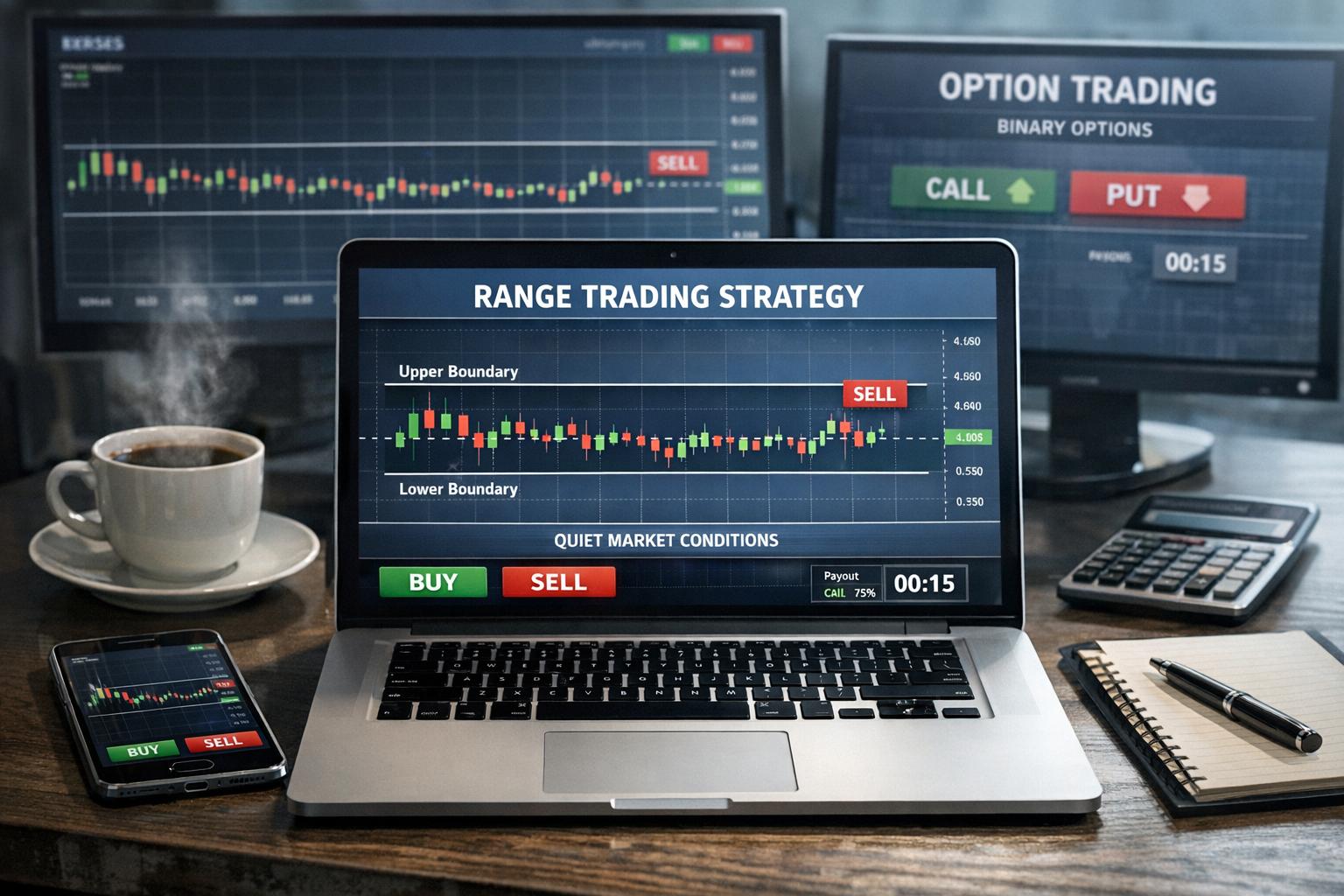
Range trading in binary options involves setting two boundaries, commonly referred to as the upper limit and the lower limit. The trader selects a contract in which the payout is triggered if the asset’s price remains between these predefined levels at the moment of expiration. If the price touches or breaches either boundary before expiration, the contract typically expires as a loss, depending on the broker’s contract specifications.
The structure of a range trade requires careful observation of current price behavior. In practice, traders examine historical price action to identify support and resistance levels. Support refers to a price level where downward movements tend to pause due to increased buying interest, while resistance indicates a level where upward movement has historically slowed due to selling pressure. When price oscillates between these levels without establishing a directional trend, it forms a trading range.
Binary options brokers that offer range contracts typically define the boundaries in advance. In some cases, traders may select from several predefined ranges with different risk-return parameters. The narrower the range, the higher the potential payout, since the probability of remaining inside a tight corridor is lower. Conversely, wider ranges generally offer lower payouts but higher statistical likelihood of success.
Price Behavior Within a Range
Price behavior inside a trading range is characterized by repeated bounces between support and resistance. Volume may decline relative to trending phases, and indicators often show neutral readings. The absence of strong economic catalysts can contribute to this market state. Currency pairs during off-peak sessions and certain equities outside earnings periods often exhibit range-bound tendencies.
It is important to distinguish between a genuine stable range and a temporary consolidation that precedes a breakout. In the latter case, volatility may compress temporarily before expanding sharply, which increases the risk of boundary breaches in range contracts.
Key Components of a Range Trade
Asset Selection: Selecting an appropriate asset is fundamental. Assets with historically low volatility, stable economic environments, or predictable trading sessions are more likely to remain within boundaries during short-term contracts. Major currency pairs frequently demonstrate range behavior during certain sessions, particularly when major markets are closed.
Time Frame: The contract duration should align with expected stability. Shorter time frames, such as one hour or less, may reduce exposure to unexpected news events. However, extremely short expirations can introduce noise-based fluctuations. Daily expiration periods may be suitable when macroeconomic calendars show no significant announcements.
Expiration Time: Timing is critical. Range trading requires assessing not only whether the asset is currently stable but whether it is likely to remain stable throughout the contract period. Scheduled events such as central bank announcements, corporate earnings releases, and political developments can disrupt quiet conditions, even if the market appears calm at the time of entry.
Market Conditions Favorable for Range Trading
Markets alternate between trending periods and consolidating periods. Consolidation often occurs after strong directional moves, when participants reassess valuation levels. It may also arise during seasonal slowdowns or between major economic data releases. In these conditions, liquidity providers and institutional participants may reduce aggressive positioning, resulting in price containment.
Volatility indicators such as the Average True Range (ATR) can help identify contracting market states. When ATR readings decline steadily over several sessions, it suggests diminishing price expansion. However, volatility contraction alone does not guarantee continued stability; it may precede expansion.
Range trading is most practical when price repeatedly respects established support and resistance zones without producing higher highs or lower lows. Sideways movement should persist long enough to demonstrate structural stability rather than temporary hesitation.
Risk Structure in Range Contracts
The risk structure of binary options range trading differs from traditional spot trading. In spot markets, a trader holding a range-based strategy might place multiple trades near support and resistance with stop-loss levels. In binary range contracts, the entire trade depends on a single outcome at expiration.
The predefined payout ratio determines the risk-reward profile. For example, if a broker offers a 70 percent return for a successful range contract, the trader must win a significant proportion of trades to maintain profitability over time, factoring in total capital exposure. Since the loss is typically total capital allocated to the contract, capital management becomes central to long-term sustainability.
Range contracts are particularly sensitive to unexpected volatility spikes. Even a brief breakout, depending on contract rules, can invalidate the position. Some brokers define the contract result solely at expiration, while others treat boundary touches as immediate breaches. Understanding contract specifications is essential.
Technical Analysis in Range Trading
Technical analysis plays an essential role in identifying potential ranges and estimating breakout risks. Although no tool can guarantee outcome certainty, consistent application of analytical methods can refine trade selection.
Moving Averages
Moving averages smooth out price data to reveal underlying direction. In range conditions, shorter-term and longer-term moving averages often converge and flatten, indicating the absence of a dominant trend. A flat 50-period moving average overlapping with a 200-period moving average can signal equilibrium. Repeated crossovers without sustained separation further confirm the lack of directional strength.
However, moving averages alone cannot define precise boundaries. They serve primarily as confirmation tools indicating whether trending bias is weak enough to consider a range strategy.
Bollinger Bands
Bollinger Bands measure volatility by plotting standard deviation envelopes around a moving average. When bands contract significantly, volatility compression is evident. Price oscillating between upper and lower bands without consistent expansion suggests stable containment.
In strong range environments, the upper Bollinger Band may align approximately with resistance, while the lower band aligns with support. Traders may compare the broker-defined binary range boundaries with these indicators to assess probability alignment.
Relative Strength Index (RSI)
The Relative Strength Index can provide additional confirmation. In ranging markets, RSI frequently moves between overbought and oversold thresholds without remaining extended for prolonged periods. Readings oscillating between 30 and 70 without persistent extremes often support the presence of consolidation.
Volume Analysis
Lower trading volume relative to previous trend periods can reinforce confidence in containment. However, volume conditions differ across asset classes, and forex markets, for example, rely on tick volume approximations rather than centralized exchange data.
Setting Boundaries Effectively
In some cases, brokers determine the range boundaries. When traders have discretion in selecting contracts with varying corridor widths, careful evaluation is necessary. Selecting a boundary too close to current price increases breakout probability, whereas an excessively wide boundary may reduce payoff ratios below acceptable risk thresholds.
A disciplined approach involves comparing historical price swings during similar volatility periods. If an asset has fluctuated within a 40-point corridor over the last several sessions, selecting a 20-point corridor may expose the trade to higher breach risk than historical data supports.
Additionally, traders must incorporate economic calendar awareness. Even if historical movement is limited, an upcoming monetary policy announcement may expand volatility beyond prior norms.
Advantages of Range Trading
Range trading presents certain structural benefits under suitable conditions. One advantage is that it does not require forecasting directional movement. Neutral market forecasts may be easier to formulate during data gaps or transitional periods.
The strategy may also contribute to portfolio diversification. A trader who primarily employs directional contracts may incorporate range strategies during consolidations rather than remaining inactive. This can provide broader tactical flexibility.
Because market conditions cycle, the ability to identify stable periods and adapt strategy accordingly may improve overall efficiency in resource allocation.
Limitations and Risks
Despite potential advantages, range trading involves identifiable constraints. Breakout risk remains constant. Markets do not remain static indefinitely, and suppressed volatility often leads to expansion phases. A sudden news release or unexpected macroeconomic development can move price beyond both support and resistance rapidly.
Furthermore, binary payoff structures limit recovery flexibility. In traditional trading, partial losses can be managed with stop adjustments or hedging. Binary contracts conclude definitively at expiration.
Another limitation involves overestimating stability. Traders may interpret short-term consolidation as an established range without sufficient confirmation. Acting prematurely before range structure solidifies increases the probability of contract failure.
Psychological and Operational Discipline
Although range trading relies heavily on technical structure, disciplined execution remains necessary. Traders must avoid entering range contracts during ambiguous transitions between consolidation and emerging trends. Patience in waiting for consistent sideways confirmation reduces exposure to random price swings.
Operational discipline also includes controlled capital allocation. Because returns per trade are fixed, overexposure to individual contracts increases volatility in account performance. Risk per trade should remain consistent relative to account size.
Integrating Fundamental Awareness
Even when focusing primarily on technical signals, awareness of macroeconomic context is essential. Range-bound behavior often reflects temporary uncertainty before new information emerges. Scheduled economic releases, earnings reports, or policy decisions can terminate quiet phases abruptly.
Monitoring scheduled data releases reduces unexpected volatility exposure. If a high-impact announcement is due before expiration, postponing range entries or selecting shorter expirations may mitigate risk.
Comparing Range Contracts to Other Binary Structures
Binary options include various contract types, such as high/low, one-touch, and ladder options. High/low contracts require predicting direction. One-touch contracts involve anticipating whether price will reach a specified level. Range contracts, in contrast, reward containment.
Selecting among these structures depends on volatility context. Trending markets often favor directional or breakout-based contracts, while stable markets may favor containment contracts. Adapting contract type to volatility regime aligns structure with prevailing dynamics.
Performance Evaluation
Evaluating the effectiveness of a range trading approach requires consistent record keeping. Traders should document volatility conditions, contract width, expiration duration, and contextual factors such as economic releases. Over time, pattern recognition may reveal which conditions correlate with higher success probability.
Statistical assessment should include calculation of win ratio relative to required breakeven thresholds determined by payout percentage. For example, a 70 percent payout requires a win rate exceeding approximately 59 percent to offset losses. Analytical review of historical trades provides objective insight into whether the strategy is sustainable.
Adapting to Changing Conditions
Financial markets evolve continuously. A range valid over several days may dissolve as new capital flows enter the market. Effective range trading requires ongoing monitoring rather than static assumptions.
Volatility expansion signals may include increasing ATR readings, widening Bollinger Bands, or strong directional candlestick formations breaking prior highs or lows. When these signals emerge, transitioning away from range strategies toward trend-aligned contracts may be appropriate.
Conclusion
Binary options range trading is a structured method designed for environments in which price stability is more probable than directional expansion. By defining upper and lower limits and selecting expiration periods aligned with subdued volatility, traders attempt to capitalize on consolidation phases.
Successful implementation requires accurate identification of genuine range conditions, disciplined timing relative to economic events, thoughtful boundary assessment, and consistent capital management. Technical tools such as moving averages, Bollinger Bands, RSI, and volatility measurements provide structured frameworks for evaluating containment probabilities.
While range trading can align effectively with quiet market conditions, it does not eliminate uncertainty. Breakout risk, payout structure limitations, and volatility regime shifts remain inherent considerations. A systematic approach that integrates technical analysis, fundamental awareness, and performance evaluation can improve the practical application of this strategy within the broader context of binary options trading.
This article was last updated on: August 9, 2026