
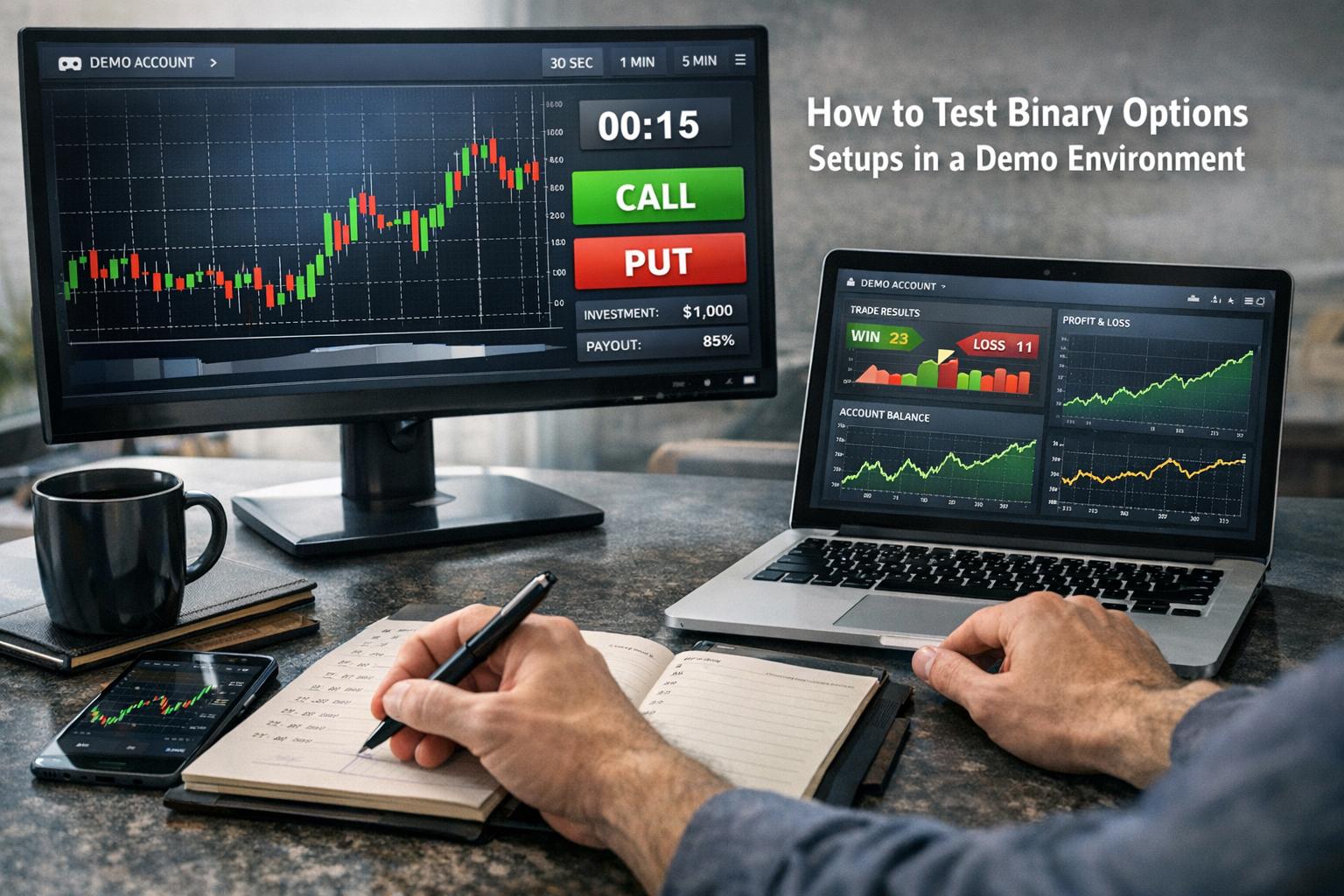
How to Test Binary Options Setups in a Demo Environment
Understanding Binary Options Demo Accounts
Binary options are derivative financial instruments that allow traders to speculate on the directional movement of underlying assets within a predefined time frame. Unlike traditional trading, where profits or losses depend on the magnitude of price movement, binary options typically involve a fixed payout structure. The trader predicts whether the price of an asset will be above or below a specific level at expiration. If the prediction is correct, a predetermined return is received; if incorrect, the invested amount is lost.
Because of the structured and time-sensitive nature of binary options, careful preparation is essential before committing real funds. One of the most effective preparation tools available is the binary options demo account. A demo account offers a simulated environment that replicates the trading conditions of a live account while using virtual capital. This allows individuals to test trading methods, understand platform mechanics, and evaluate strategy performance without financial exposure.
A well-structured demo environment supports systematic learning. It provides an opportunity to observe market behavior, apply analytical tools, and practice trade execution. While demo trading does not replicate every psychological aspect of live trading, it plays a critical role in building technical competence and procedural familiarity.
Key Features of a Demo Account
Simulated Trading Environment: Demo accounts are designed to replicate real-time market conditions by displaying live or near-live pricing data. This simulation allows traders to understand price fluctuations, volatility patterns, and the influence of economic events on specific assets. The execution interface, order placement mechanics, expiry settings, and payout structures generally mirror those in live accounts. This consistency ensures that skills developed in the demo setting translate to real trading conditions.
Virtual Funds: Instead of depositing actual capital, users receive a balance of virtual money. The amount provided may vary by platform, but it is generally sufficient to simulate multiple trades across different assets and timeframes. Virtual funds eliminate financial risk, enabling systematic experimentation with trading approaches. Traders can test aggressive or conservative strategies and observe outcomes objectively without monetary consequences.
Access to Trading Tools: Most reputable brokers provide identical tools in both demo and live accounts. These tools may include real-time charts, various timeframe selections, technical indicators such as moving averages and oscillators, trend identification tools, and economic calendars. Access to the full suite of analytical utilities allows traders to develop and test structured trading frameworks. Practicing with these tools in a demo account improves efficiency and familiarity when transitioning to live markets.
Multiple Asset Classes: Demo platforms often include the same asset categories available in live accounts, such as currency pairs, commodities, indices, and equities. Exposure to different asset types allows traders to determine which instruments align best with their analytical approach and risk tolerance.
Performance Tracking: Many demo accounts include trade history logs and performance statistics. These records provide detailed data regarding entry time, expiry selection, stake size, and outcome. Reviewing this information enables methodical performance analysis and supports structured improvement.
How Binary Options Demo Accounts Function
A binary options demo account operates by simulating the mechanics of the broker’s trading platform. When a trader selects an asset, chooses an expiry time, and predicts a price direction, the system processes the trade using live market pricing data. If the price meets the predicted condition at expiration, a fixed virtual payout is credited to the account balance. If the condition is not met, the invested amount is deducted from the virtual funds.
The core functionality mirrors the live environment, including payout ratios, trade confirmation procedures, and time-based expirations. This structure enables users to become comfortable with selecting trade sizes, adjusting expiry windows, and managing overall portfolio allocation.
However, it is important to understand that while market price feeds are usually real, execution conditions may differ slightly from live trading. Slippage, execution delays, or liquidity-driven variations may be less apparent in demo settings. Therefore, demo performance should be interpreted as indicative rather than definitive.
Steps to Test Binary Options Setups
Choose a Reliable Broker
The quality of a demo experience depends largely on the broker providing it. A reliable broker should offer a demo account that closely mirrors live trading conditions. This includes realistic payout percentages, identical execution processes, and access to full analytical tools.
Additionally, the broker should maintain a stable platform infrastructure. Platform stability is particularly important in binary options trading due to the time-sensitive nature of expiries. A poorly functioning demo platform will distort performance analysis and hinder meaningful testing.
Traders should also verify whether the demo account expires after a limited period or remains accessible indefinitely. Ongoing access allows extended evaluation and refinements before transitioning to live capital.
Familiarize Yourself with the Platform
Before testing specific strategies, it is essential to understand the mechanics of the trading environment. This involves learning how to select assets, adjust trade sizes, define expiration periods, and confirm order entries. Familiarity with chart settings, indicator placement, and timeframes is also fundamental.
Attention should be given to understanding payout percentages for various instruments and expiry types. Since binary options profits are fixed, identifying variations in payout structures across assets can influence strategic asset selection.
Operational fluency reduces execution errors and allows focus to remain on strategy logic rather than technical navigation.
Develop and Implement a Strategy
Effective use of a demo account requires a structured trading plan. Random trade placement does not generate meaningful insights. A well-defined strategy outlines:
Entry criteria, such as specific indicator alignments or price structure signals.
Expiry selection rules, based on timeframe and volatility analysis.
Stake allocation methodology, defining consistent risk per trade.
For example, a trader may design a setup that requires price to break above a defined resistance level while supported by momentum indicators. The strategy should detail the precise confirmation signals and maximum capital exposure per trade.
Once the framework is established, it should be applied consistently across a statistically significant number of trades. This approach ensures performance data reflects strategy viability rather than isolated outcomes.
Analyze Results and Adjust
After executing multiple trades, systematic evaluation becomes critical. Reviewing trade logs enables identification of patterns in winning and losing trades. Analysis should focus on objective factors, including asset performance, time-of-day effectiveness, expiry selection, and market conditions during entry.
Adjustments may involve refining entry signals, modifying expiration periods, or reducing stake sizes during volatile sessions. Changes should be incremental and tested through additional structured trials rather than immediate broad alterations.
Consistent documentation supports disciplined improvement and prevents repetitive strategic errors.
Benefits of Using Demo Accounts
Demo accounts provide multiple structural advantages for traders at various experience levels. For beginners, they offer foundational exposure to market mechanics and trading terminology. For experienced individuals, they create a testing ground for new techniques or refinements without altering live capital allocation.
One significant advantage is the ability to observe how market conditions influence binary outcomes. Since expiration timing plays a central role in profitability, traders can experiment with shorter and longer durations to determine suitability.
Another advantage is the opportunity to compare asset responsiveness to particular strategies. Certain currency pairs may respond more predictably to trend-based setups, while indices may perform better under reversal frameworks.
Opportunity to Practice Risk Management
Risk management is integral to consistent trading performance. Although demo funds are virtual, practicing disciplined allocation reinforces habits essential for live trading.
Traders can experiment with fixed-percentage risk models, where each trade represents a consistent proportion of account balance. Alternatively, variable risk models may be tested, with adjustments based on market volatility or perceived probability.
Practicing capital preservation techniques—such as limiting consecutive trade exposure or establishing maximum daily trade counts—allows traders to understand drawdown dynamics. Monitoring simulated equity curves provides insight into how volatility affects account balance fluctuations over time.
Improving Emotional Control
While demo accounts do not replicate the full emotional intensity of live trading, they provide exposure to performance cycles. Experiencing sequences of wins and losses allows traders to observe psychological tendencies, such as overtrading after gains or revenge trading after losses.
Developing disciplined responses to simulated losses supports stronger emotional regulation during real-money trading. Establishing procedural rules in demo trading encourages adherence to strategy logic rather than impulsive reaction.
Building Statistical Confidence
Binary options trading requires accuracy above a certain threshold to offset payout ratios. A demo account allows traders to calculate win rates, average returns, and risk-to-reward implications based on historical performance.
By analyzing several dozen or hundreds of trades, individuals can determine whether their strategy exceeds the required accuracy level for profitability. This data-driven approach enhances decision-making and reduces reliance on assumptions.
Common Limitations of Demo Trading
Despite their advantages, demo accounts possess limitations that should be acknowledged. The absence of real financial consequences reduces emotional intensity, potentially leading to riskier trade selection compared to live conditions.
Additionally, certain brokers may not perfectly replicate execution speeds or slippage effects. Market gaps around economic announcements or high-volatility periods may impact live trades differently than demo trades.
Recognizing these limitations encourages realistic expectations and prevents overconfidence based solely on simulated performance.
Transitioning from Demo to Live Trading
The shift from demo to live trading should occur only after consistent, statistically supported profitability in the simulated environment. Traders should transition gradually, beginning with minimal capital allocation and maintaining the same structured strategy tested in the demo account.
Maintaining identical risk parameters during the initial live phase supports continuity. Any deviation from tested stake sizes or trade frequency can distort performance evaluation.
Continuous performance review remains important after transitioning. Live trading conditions introduce emotional variables that may affect execution quality, making disciplined review essential.
Conclusion
Testing binary options setups within a demo account environment represents a foundational step in developing trading competence. The simulated platform replicates market conditions, provides access to analytical tools, and enables structured evaluation of strategies without financial exposure.
Through systematic practice, traders can refine entry criteria, optimize expiry selection, and implement consistent risk management techniques. Although demo trading does not replicate all aspects of live-market psychology, it establishes technical fluency and statistical insight.
A disciplined approach to demo account utilization—emphasizing structured testing, performance analysis, and gradual transition—supports informed participation in binary options markets.
This article was last updated on: July 1, 2026