
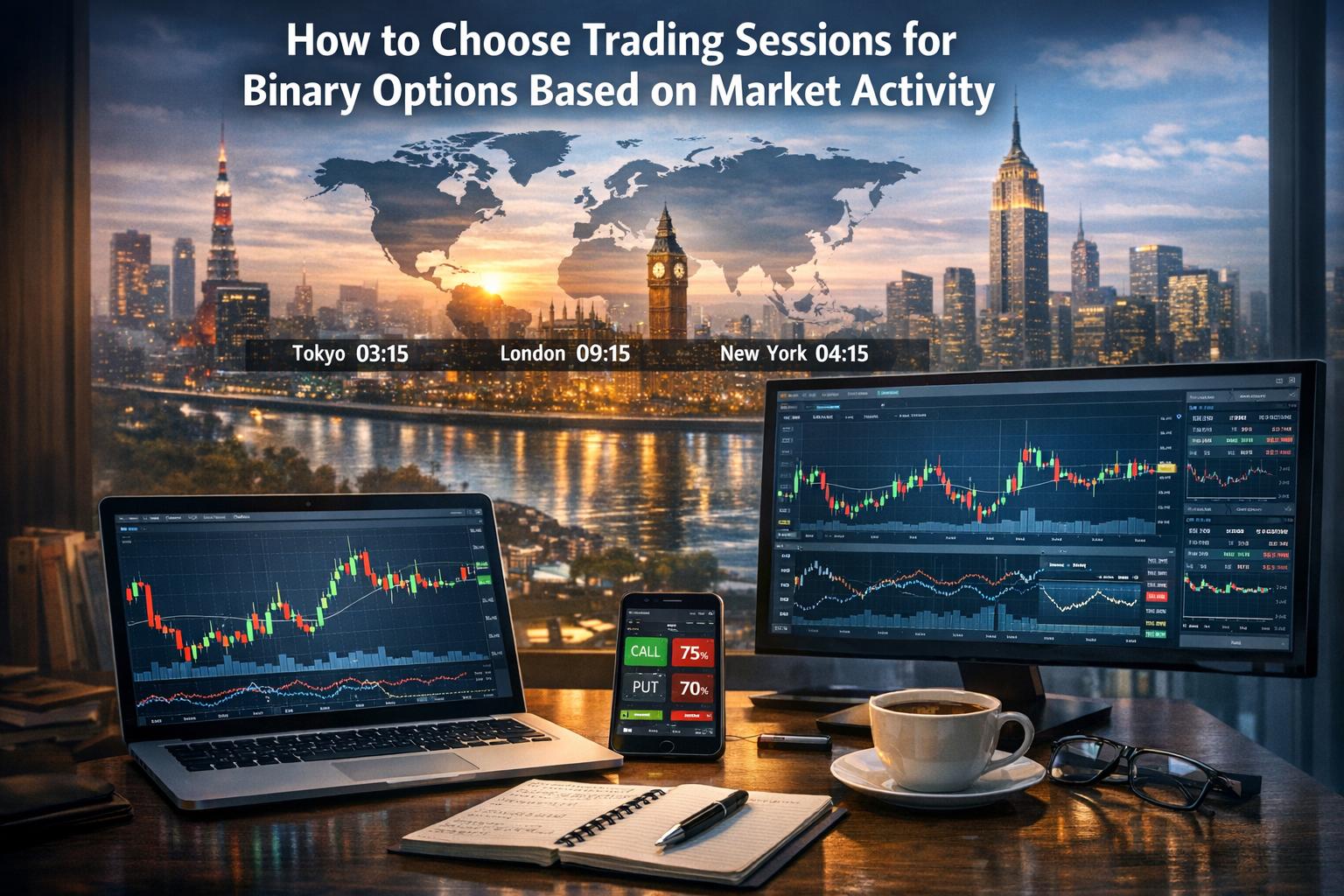
How to Choose Trading Sessions for Binary Options Based on Market Activity
Understanding Trading Sessions
In the world of binary options trading, market activity varies significantly across different trading sessions. Understanding these sessions is crucial for any trader seeking to refine timing, manage risk, and structure trades effectively. The global foreign exchange market operates twenty-four hours a day, five days a week. This continuous operation is made possible by the existence of four major trading sessions: Sydney, Tokyo, London, and New York. Each session reflects the business hours of major financial centers and carries distinct characteristics in terms of liquidity, volatility, trading volume, and dominant currency pairs.
Binary options traders, who rely heavily on timing and short-term price movements, often place particular emphasis on session-specific behavior. Unlike long-term investors, binary options traders focus on defined expiration times, sometimes as short as minutes or hours. As a result, understanding when markets are most active, when spreads are tighter, and when price movements are more predictable becomes essential. The structure of trading sessions can influence everything from breakout strategies to range-bound approaches.
Although the forex market is decentralized and does not operate from a single physical exchange, trading activity tends to cluster around major global financial hubs. When banks, corporations, hedge funds, and institutional traders in a region are active, liquidity increases and market dynamics shift. These shifts shape price behavior in ways that can either support or undermine specific trading strategies.
Structure of the Global Trading Day
The forex trading day follows the sun, beginning in the Asia-Pacific region and moving westward through Europe into North America. As one session closes, another opens, creating periods of overlap that are often associated with heightened liquidity. These overlaps are especially important in binary options trading because they frequently produce price fluctuations that can trigger short-term directional trades.
The four primary sessions are typically defined according to Coordinated Universal Time (UTC), though local daylight saving adjustments may shift opening and closing hours. Despite these time variations, the relative sequence of sessions remains consistent. The Sydney session initiates the trading week, followed by Tokyo, then London, and finally New York.
Each session has a distinctive market profile, influenced by regional economic activity, institutional flows, and macroeconomic announcements. Recognizing these differences allows traders to adapt their strategies instead of applying a single method uniformly across all hours of the day.
Sydney Session
The Sydney session marks the beginning of the global trading cycle. While it is often considered less volatile than later sessions, it plays an important structural role in establishing preliminary price levels and sentiment for the upcoming day. Liquidity during this session is generally moderate, and price ranges may remain narrower compared to those seen during London or New York hours.
Currency pairs involving the Australian dollar (AUD) and New Zealand dollar (NZD) tend to exhibit more consistent activity during this time. Economic data releases from Australia and New Zealand, including employment reports, central bank statements, and trade data, can influence price direction. Additionally, developments in commodity markets may affect these currencies due to their economic correlation with exports of raw materials.
For binary options traders employing range-bound strategies, the Sydney session may offer relatively stable price channels. Lower volatility can create conditions where support and resistance levels hold more reliably. However, traders seeking strong directional momentum may find fewer opportunities during this period unless driven by specific regional news.
Tokyo Session
The Tokyo session overlaps partially with Sydney and represents the primary Asian trading period. Tokyo is one of the largest financial centers in the world, and activity tends to increase compared to the earlier hours of Sydney alone. The Japanese yen (JPY) becomes particularly active, and yen-related currency pairs often display clearer movement patterns.
Institutional participation increases during this session as Japanese banks and corporations engage in currency transactions. Exporters and importers adjust positions, and investors respond to domestic economic indicators such as inflation data, industrial production figures, and policy statements from the Bank of Japan.
During the Tokyo session, technical levels established in earlier hours may be tested or redefined. Price trends that emerge can extend into the European session if no significant reversal occurs. For binary options traders utilizing breakout strategies, this session can provide moderate opportunities, particularly following overnight consolidations.
However, volatility remains lower than during the London or New York sessions in many major currency pairs, especially those not directly tied to the Japanese economy. Traders focusing on Asian currency crosses may observe more pronounced activity than those trading primarily European or North American pairs.
London Session
The London session is widely regarded as the most active and influential trading period. London has historically been a central hub for foreign exchange transactions, and a substantial proportion of global forex volume passes through European markets during this time. Liquidity increases significantly, spreads often narrow, and price movements become more dynamic.
European currencies such as the euro (EUR), British pound (GBP), and Swiss franc (CHF) experience heightened activity. Major economic releases from the United Kingdom and the Eurozone are typically scheduled during these hours, contributing to rapid price adjustments. Data such as gross domestic product figures, interest rate decisions from the European Central Bank, and employment reports frequently generate measurable volatility.
One of the defining characteristics of the London session is its overlap with the Tokyo session during early European hours and later with the New York session. These overlaps can intensify trading volume. When multiple financial centers operate simultaneously, liquidity flows increase as institutions react to shared information and adjust global portfolios.
For binary options traders, the London session often offers structured price movements suitable for short-term directional trades. Breakouts from Asian session ranges commonly occur during early London hours. Traders applying momentum strategies may find higher success probabilities when liquidity expands and technical levels break with conviction.
New York Session
The New York session represents the final major phase of the global trading day. It overlaps significantly with the London session during its initial hours, forming one of the most active periods in the forex market. The United States financial markets exert considerable influence over global capital flows, and macroeconomic data releases frequently originate during this session.
The US dollar (USD), as the world’s primary reserve currency, participates in the majority of forex transactions. Therefore, movements during the New York session can affect nearly all major currency pairs. Economic indicators such as non-farm payroll reports, inflation data, retail sales figures, and Federal Reserve announcements often result in pronounced volatility.
Binary options traders may find substantial opportunities during these hours, particularly when trading USD pairs. However, the increased volatility also requires careful risk management. Rapid price swings can produce both opportunities and challenges, especially for short expiration contracts.
After the London market closes, volatility may decrease gradually during the latter portion of the New York session. As liquidity tapers off, price action may consolidate or reverse earlier intraday trends. Traders should remain aware of this potential shift in market structure as the trading day progresses.
Session Overlaps and Their Significance
Session overlaps play a critical role in shaping market behavior. The transition periods when two major financial centers operate simultaneously tend to produce higher trading volume and heightened volatility. The London–New York overlap is particularly notable because it combines two of the largest financial markets.
During overlaps, institutional participation reaches peak levels. Hedge funds, multinational corporations, and investment banks engage in higher-frequency transactions, which can amplify price movement. Liquidity improves, spreads often narrow further, and technical breakouts may unfold with greater intensity.
For binary options traders, overlaps can provide favorable conditions for momentum-based trades. However, traders should recognize that heightened volatility can also lead to rapid reversals. Careful timing and confirmation are essential when initiating positions during these dynamic periods.
Factors Influencing Market Activity
Market activity during each session is shaped by a range of economic and structural factors. Understanding these influences enables traders to align strategies with prevailing conditions rather than relying solely on technical indicators.
Economic Reports
Economic indicators, such as gross domestic product reports, unemployment rates, inflation figures, and central bank statements, regularly influence currency valuations. These scheduled releases can generate predictable surges in volatility during specific sessions.
Traders often monitor economic calendars to anticipate these events. When significant data is expected, market participants may adjust positions ahead of time, causing gradual price shifts even before the official release. Upon publication, rapid price movements may occur as traders incorporate new information into their expectations.
Binary options traders must consider the timing of these events relative to expiration periods. Short-term contracts initiated immediately before major announcements may face heightened uncertainty. Some traders prefer to wait for the initial reaction to unfold before entering positions.
Geopolitical Events
Geopolitical developments can influence currency markets beyond scheduled economic releases. Elections, trade negotiations, regulatory changes, and diplomatic tensions can alter investor sentiment and capital flows. These events may emerge suddenly, producing unexpected volatility.
While geopolitical news can affect markets during any session, its immediate impact may be most visible when major trading centers are open and liquidity is available to facilitate large position adjustments. Traders who remain informed about international developments are better positioned to interpret sudden price shifts within the context of broader events.
Monetary Policy and Central Bank Actions
Central banks play a pivotal role in determining currency valuations through interest rate decisions, monetary policy guidance, and market interventions. Statements from central bank officials often occur during their respective regional sessions and can significantly affect volatility patterns.
Interest rate differentials influence capital allocation, and adjustments to these rates may produce sustained trends. For binary options traders operating on shorter time frames, immediate reactions to policy announcements can generate rapid directional moves suitable for defined expiration trades.
Selecting the Right Trading Session
Choosing the most suitable trading session depends on individual trading objectives, preferred currency pairs, and tolerance for volatility. Traders who favor stable price action and technical range strategies may gravitate toward quieter hours, whereas those seeking stronger trends may prefer the London or New York sessions.
Practical considerations such as geographic location and personal schedule also influence session selection. Consistency in monitoring specific sessions can enhance familiarity with typical price behavior during those periods. Over time, traders may identify patterns unique to certain hours, enabling more effective planning.
Experimentation with demo accounts or reduced position sizes can help determine which sessions align best with a trader’s method. Tracking performance by session allows objective evaluation of success rates under different market conditions.
Integrating Session Awareness into Strategy
Successful binary options trading often involves aligning technical analysis with session-based context. Breakout strategies may perform better during high-liquidity overlaps, while support and resistance strategies may prove more effective during quieter intervals.
By integrating session awareness with economic calendar analysis and risk management principles, traders can create structured frameworks rather than relying solely on isolated price signals. Over time, understanding the rhythm of global trading sessions contributes to more consistent execution and improved decision-making.
By recognizing the characteristics of each trading session and remaining attentive to influential economic and geopolitical events, traders can make more informed decisions. An appreciation of session-driven market dynamics provides a practical foundation for evaluating volatility, selecting expiration times, and refining binary options strategies within the continuous structure of the global forex market.
This article was last updated on: April 13, 2026