
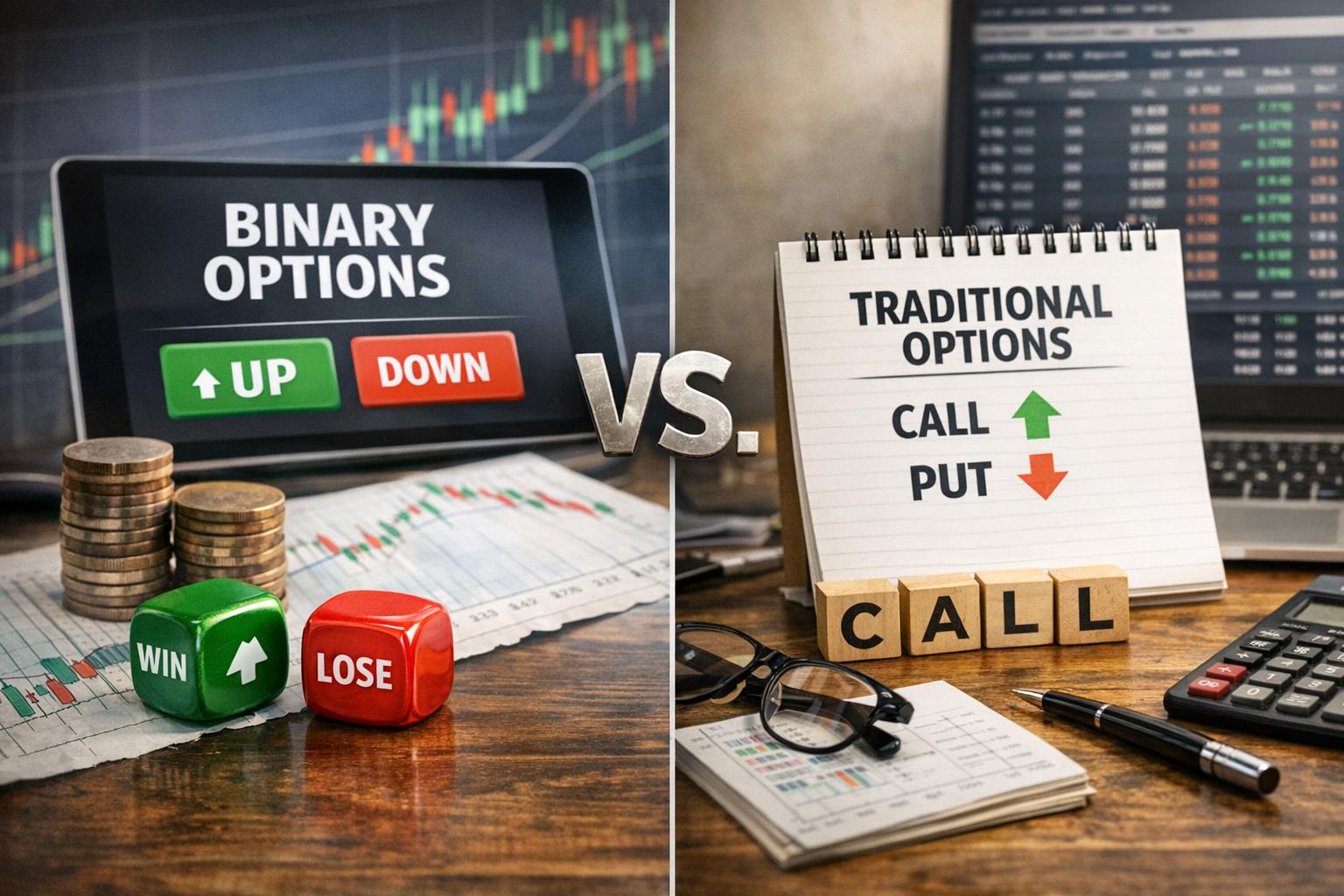
Binary Options vs. Traditional Options: Structural Differences Explained
Understanding Binary Options
Binary options are a type of financial derivative that allows traders to speculate on the direction of an underlying asset’s price within a defined period of time. The defining feature of a binary option is its all-or-nothing payoff structure. At expiration, the outcome is limited to one of two results: a predetermined fixed return if the trader’s prediction is correct, or a total loss of the capital allocated to that position if the prediction is incorrect. Because the result is limited to these two possibilities, the instrument is described as “binary.”
The underlying assets associated with binary options can include currencies, commodities, stocks, or market indices. Rather than purchasing the asset itself, the trader is effectively making a directional forecast about whether the asset’s price will be above or below a specified level at the time of expiration. The pricing structure is generally based on short-term movements, and the settlement is immediate once the expiry time is reached.
Binary options are typically structured around a simple question: Will the asset price be above or below a certain level at expiration? If the answer is correct according to the terms of the contract, the trader receives a fixed payout, often expressed as a percentage of the invested amount. If the answer is wrong, the full stake is forfeited. The straightforward nature of this structure is one of the primary reasons binary options attract attention from retail participants.
Key Characteristics of Binary Options
One of the most significant characteristics of binary options is their fixed risk and fixed reward framework. Before entering a trade, the trader knows the exact amount that can be gained and the exact amount that can be lost. This differs from many other financial instruments in which profits and losses can fluctuate continuously depending on price changes. The clearly defined outcome simplifies decision-making, as there is no need to calculate complex payoff scenarios.
Another defining feature is the relatively short duration of many binary option contracts. Expiry times can range from less than a minute to several hours or, in some cases, days. Short-term expirations are common and are designed to capture immediate price fluctuations rather than long-term trends. This time structure encourages frequent trading activity and rapid capital turnover.
Binary options also tend to be offered through online platforms that provide simplified interfaces. These platforms generally display the asset’s live price chart, the selected expiry time, the potential return percentage, and the investment amount. The user selects the direction and confirms the transaction. The process is designed to minimize operational complexity.
Settlement mechanics are equally straightforward. At the expiration moment, the platform determines whether the option is “in the money” or “out of the money.” If the predefined condition is satisfied, the fixed return is credited to the trader’s account. If not, the investment amount is deducted.
Despite this apparent simplicity, pricing in binary options is influenced by market volatility, implied probability, and the broker’s internal pricing model. The payout percentage offered can vary depending on market conditions and the perceived likelihood of the predicted event occurring. Lower probability outcomes may be associated with higher fixed returns and vice versa.
Exploring Traditional Options
Traditional options differ substantially in structure and application. They are standardized financial contracts that grant the holder the right, but not the obligation, to buy or sell an underlying asset at a predetermined strike price on or before a specific date. Traditional options are considered more versatile instruments and are fundamental components of derivatives markets globally.
Unlike binary options, traditional options derive their value from multiple variables, including the underlying asset price, time remaining until expiration, implied volatility, interest rates, and dividends where applicable. The pricing of these instruments commonly relies on mathematical models, such as the Black-Scholes framework, which estimate fair value based on these inputs.
Traditional options provide the holder with flexibility. If the option is favorable, it may be exercised. If it is not, it can be sold in the secondary market prior to expiration, assuming liquidity exists. This tradability introduces opportunities to manage risk dynamically rather than waiting passively for expiration.
Attributes of Traditional Options
Traditional options are generally divided into two primary categories: call options and put options. A call option gives its holder the right to purchase the underlying asset at the strike price, while a put option grants the right to sell the asset at the strike price. These contracts can be used in various ways, depending on the investor’s objectives.
One common application is hedging. Investors holding a portfolio of stocks may purchase put options as a form of downside protection. If the market declines, gains in the put option can offset losses in the underlying holdings. This protective function makes traditional options an important risk management tool.
Another application is income generation. Investors who hold shares of a company may sell call options against those shares to collect premium income. This strategy, commonly referred to as covered call writing, generates revenue in exchange for limiting some potential upside.
Traditional options also support sophisticated speculative strategies. Traders can combine multiple contracts with different strike prices or expiration dates to express specific market views. The payoff in traditional options is not fixed in the same binary manner; instead, it varies continuously depending on how far the underlying asset’s price moves relative to the strike price.
Expiration terms for traditional options vary significantly. Contracts may expire within days, months, or even years in the case of long-dated options known as LEAPS. The extended expiration range allows participants to align their positions with both short-term expectations and long-term projections.
Traditional options are primarily traded on regulated exchanges such as the Chicago Board Options Exchange (CBOE) and other major derivatives exchanges worldwide. Exchange trading ensures standardization, transparency, and central clearing, which reduces counterparty risk and enhances market integrity.
Structural Differences
Although both instruments are categorized as options, binary options and traditional options differ fundamentally in structure, pricing mechanics, regulatory oversight, and practical applications.
Payout and Risk
The most significant distinction concerns the payout structure. Binary options offer a fixed payout that does not change regardless of how far the underlying asset moves beyond the specified threshold. Whether the asset exceeds the strike price by a small margin or a large margin, the payout remains predetermined.
Traditional options, by contrast, provide a variable payoff profile. In a call option, for example, potential profit theoretically increases as the underlying asset’s price rises above the strike price, less the premium paid. Losses are generally limited to the premium paid when buying options, but for sellers of options, potential losses can exceed the premium received.
This variable payoff allows traditional options to capture large price movements more effectively. In binary options, once the specified condition is met, no additional profit accrues. This ceiling on returns simplifies the reward profile but limits upside participation.
Risk exposure also differs. With binary options, the maximum potential loss is equal to the initial investment in each trade. In traditional options, risk depends on whether the participant is a buyer or seller of the contract. Buyers typically face limited loss equal to the premium, while sellers may assume more substantial risk, particularly in uncovered positions.
Pricing Mechanics
Binary options are often priced according to the implied probability that a given condition will be satisfied at expiration. If the probability of the asset finishing above the strike price is perceived as high, the payout ratio may be lower since the event is more likely. Conversely, lower-probability outcomes may offer higher fixed returns.
Traditional options are priced with greater nuance. Their premiums fluctuate based on intrinsic value and time value. Intrinsic value represents the immediate exercise value of the option, while time value reflects the possibility that favorable price movement may occur before expiration. Factors such as implied volatility significantly influence option premiums, sometimes independent of actual price movement.
Trading Environment
Binary options have historically been offered primarily through over-the-counter online platforms. In these environments, the platform operator often acts as the counterparty to the trade. As a result, pricing transparency and regulatory oversight may vary depending on jurisdiction. In some regions, binary options offered to retail clients face restrictions or prohibitions due to concerns about consumer protection.
Traditional options are traded predominantly on regulated exchanges. The exchange infrastructure introduces standardized contract specifications, transparent reporting of prices and volumes, and clearinghouses that assume counterparty obligations. These features reduce counterparty risk and increase confidence in trade execution.
The regulatory framework for traditional options typically includes disclosure requirements, margin controls, and suitability assessments. This environment is generally regarded as more structured and consistent than the one associated with many over-the-counter binary options platforms.
Complexity and Functionality
In terms of complexity, traditional options clearly offer a broader range of possibilities. Market participants can construct multi-leg strategies such as spreads, straddles, strangles, butterflies, and condors. Each strategy has a distinct payoff diagram and risk profile, enabling tailored responses to expectations about volatility, direction, or time decay.
Binary options are more limited in structural variation. Most contracts revolve around directional predictions. While there are variations such as boundary options or ladder options, the overall framework remains centered on fixed outcomes. This limitation reduces strategic flexibility but also lowers the barrier to entry from a mechanical standpoint.
Traditional options also allow adjustments during the life of the contract. Positions can be closed early, rolled forward, or combined with other contracts to manage exposure. Binary options, depending on the platform, may not permit early exit or may allow it only under certain pricing conditions.
Market Participants and Use Cases
Binary options are generally associated with short-term speculation. The brief expiration cycles and fixed payoff appeal to traders seeking clearly defined scenarios. However, their utility in portfolio hedging or long-term capital management is limited by the rigid payout design.
Traditional options attract a broader spectrum of participants, including institutional investors, asset managers, hedge funds, and retail traders. Their ability to hedge risk, enhance yield, and facilitate complex speculation makes them integral to modern financial systems. Large institutional portfolios frequently rely on options markets to mitigate downside exposure or manage sensitivity to volatility.
Liquidity is another relevant factor. Traditional options on major equities and indices typically benefit from significant trading volume, leading to tighter bid-ask spreads. Higher liquidity supports efficient price discovery and reduces transaction costs. Binary options platforms, in contrast, may not provide the same depth of market transparency.
Risk Considerations
Both binary and traditional options involve financial risk. Binary options present an elevated probability of losing the entire stake on any single trade if the outcome is incorrect. Because of the short timeframes often involved, price noise and random volatility can significantly influence results. Frequent trading may compound losses if risk management practices are not applied.
Traditional options involve additional dimensions of risk, including changes in implied volatility, time decay, and liquidity constraints. Option sellers, in particular, must manage exposure carefully due to the possibility of significant losses under adverse market conditions.
Appropriate position sizing, understanding of contract specifications, and awareness of regulatory conditions are critical for participants in either market. The complexity of traditional options requires a clear comprehension of how pricing variables interact, while binary options require careful evaluation of payout ratios relative to implied probabilities.
Conclusion
Binary options and traditional options represent two distinct approaches within the broader derivatives market. Binary options are defined by their fixed payout structure, simplified mechanics, and typically short-term orientation. They provide a clearly bounded risk-reward framework in which outcomes are predetermined and easily understood in numerical terms.
Traditional options, by contrast, offer variable payouts, strategic depth, and integration into regulated exchange environments. They serve multiple functions, including hedging, income generation, and complex speculative positioning. Their valuation depends on a range of quantitative factors that contribute to a more intricate pricing structure.
Understanding the structural, operational, and regulatory differences between these instruments is essential for informed decision-making. Binary options prioritize simplicity and defined outcomes, while traditional options emphasize flexibility, scalability, and strategic breadth. The choice between them depends on an individual’s objectives, knowledge of derivatives markets, and capacity to manage financial risk within the applicable regulatory framework.
This article was last updated on: April 7, 2026