
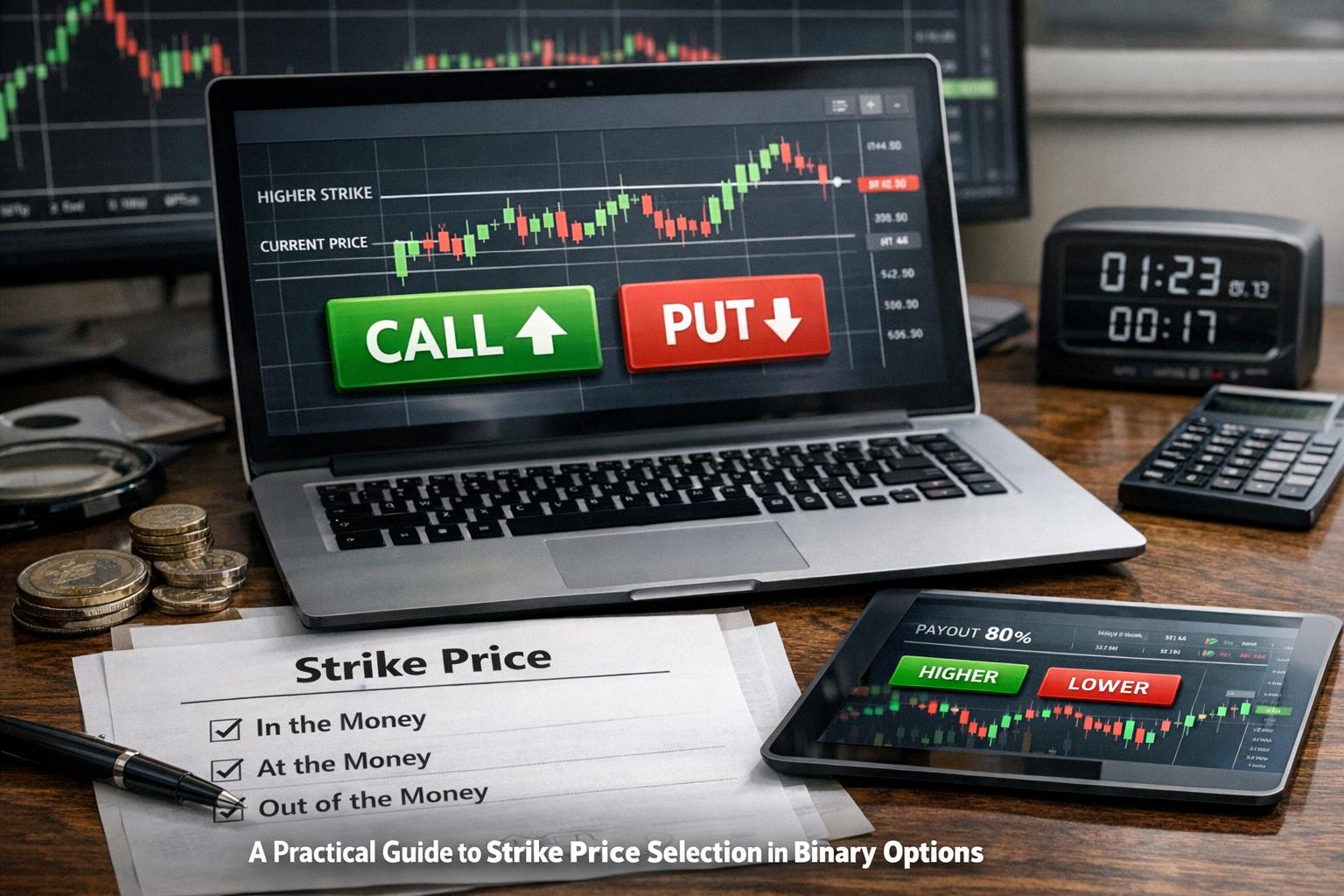
A Practical Guide to Strike Price Selection in Binary Options
Understanding Strike Price in Binary Options
In the world of binary options, the strike price is a central concept that directly determines whether a trade concludes with a predefined payout or expires without value. Binary options differ from traditional trading instruments because they offer a fixed return if specific conditions are met at expiration. At the core of those conditions lies the strike price, which acts as the reference level against which the underlying asset’s performance is measured. A clear understanding of how the strike price operates, how it interacts with market dynamics, and how it can be strategically selected is fundamental for anyone engaging in binary options trading.
Binary options are structured around a simple outcome: either the option finishes “in the money” and pays a fixed return, or it finishes “out of the money” and results in a loss of the initial stake. The strike price is the benchmark that defines this outcome. For this reason, evaluating the strike price is not merely a procedural step when placing a trade; it is the decisive factor that shapes both risk and reward. A structured approach to strike price selection can contribute to more consistent decision-making and improved performance over time.
Defining Strike Price
The strike price is the predetermined price level of the underlying asset that determines the payout conditions of the binary option. When a trader purchases a call option, the expectation is that the price of the asset will be above the strike price at the moment of expiration. If the asset’s market price closes above this level, the option settles in the trader’s favor. Conversely, if the asset’s price remains below the strike price at expiration, the option expires without value.
In the case of a put option, the process is reversed. The trader anticipates that the asset’s price will fall below the strike price before expiration. If the final price is indeed below this level, the option pays out according to its predefined terms. If the price remains above the strike price, the trade results in a loss of the invested amount.
Unlike traditional options, where profit is proportional to the distance the underlying asset moves beyond the strike price, binary options offer a fixed outcome regardless of how far the price travels. Whether the price exceeds the strike price by a minimal margin or a substantial amount, the payout remains the same. This characteristic increases the importance of precise strike price selection because even a minimal difference at expiration determines the result.
The Role of Strike Price in Trade Structure
The strike price functions as the pivot point around which the entire binary contract is structured. Every binary option contract includes a defined expiration time and a strike price. The relationship between the current market price and the strike price at the time of purchase influences both the cost of the option and its potential payout.
When the strike price is close to the current market price, the probability of the asset closing above or below it may be relatively balanced. In such cases, brokers may offer moderate payout ratios. If the strike price is set farther away from the prevailing market level, the perceived probability of the asset reaching that level by expiration decreases. This change in probability generally affects the offered return. Strike prices that are more ambitious in terms of distance from the current market price may offer higher potential payouts to compensate for the increased difficulty of achieving the desired outcome.
Understanding this relationship between probability and payout is essential. The strike price is not only a measurement point but also a determinant of risk exposure and return potential. Therefore, any analysis of binary options must account for how the strike price interacts with price probability over the chosen timeframe.
Types of Binary Options and Strike Price Variations
Different types of binary options incorporate the strike price in distinct ways. The most common type is the high/low option, where the trader predicts whether the underlying asset will be above or below the strike price at expiration. Here, the strike price is usually equivalent to the asset’s price at the time the trade is placed.
In boundary or range options, two strike prices are established, forming an upper boundary and a lower boundary. The trader predicts whether the asset’s price will remain within or break out of this range before expiration. In this structure, the strike prices create a defined trading channel. The asset’s ability or inability to breach those levels determines the trade’s success.
In touch or no-touch options, the strike price is represented as a target level that the asset must reach at least once before expiration. The final price at expiration may be irrelevant, provided the strike price is touched during the contract period. This structure assigns importance not only to the final settlement but to interim price movements.
Each variation underscores the critical function of strike prices across multiple binary formats. While the interpretation of the strike price may vary, its significance in defining outcomes remains constant.
Factors Influencing Strike Price Selection
Selecting an appropriate strike price requires consideration of several interconnected variables. Market volatility is among the most significant. Volatility measures the degree of price fluctuation over a specific time. In highly volatile markets, asset prices may move rapidly and unpredictably. Traders operating under such conditions may consider strike prices that take into account broader price swings. Conversely, in low-volatility environments, price movements may be more contained, leading to a different approach in strike price positioning.
Expiration time is another crucial variable. The length of time until the option expires directly affects the likelihood that the asset will reach or surpass the strike price. In very short-term contracts, such as those lasting minutes, price movements may be limited to small fluctuations. Traders in such timeframes often select strike prices close to the current market level. In longer-term contracts, there is greater opportunity for price development, which may justify selecting strike prices farther from the present value.
Individual risk tolerance must also be considered. Traders with higher risk acceptance may favor strike prices that are less likely to be reached but offer greater returns. Those seeking a higher probability of success might opt for strike prices nearer to current price levels, accepting potentially lower returns in exchange for increased likelihood of finishing in the money.
Market liquidity can further influence strike price decisions. Assets with high liquidity typically experience narrower spreads and more consistent price movement, making strike price assessment more stable. Illiquid markets, on the other hand, may show abrupt price changes that complicate predictions about where prices will stand at expiration.
Technical Analysis and Strike Price Determination
Technical analysis provides structured tools for evaluating potential strike price placement. By analyzing historical price data, volume, and chart patterns, traders can estimate areas where future price reactions may occur. Support and resistance levels are particularly relevant. A support level is a price zone where buying interest historically prevents further decline, while a resistance level is an area where selling pressure has historically limited upward movement.
When selecting a strike price, a trader might align it near a recognized support or resistance level. For example, a call option with a strike price slightly above a confirmed support level may be chosen if analysis suggests price will rebound. Conversely, placing a put option strike just below resistance may be considered if data indicate declining momentum near that level.
Moving averages can also inform strike selection. A short-term moving average crossing above a long-term moving average may indicate upward momentum. In such circumstances, selecting a strike price that reflects anticipated continuation of this trend can align the binary option with prevailing market direction.
Candlestick patterns add another dimension. Reversal patterns, continuation formations, and consolidation signals contribute to strike price evaluation by providing context for near-term price expectations. Technical tools do not eliminate uncertainty but support structured reasoning behind strike placement.
Fundamental Analysis and Broader Economic Context
While technical analysis focuses on price behavior, fundamental analysis examines underlying economic and financial factors that influence asset values. Economic indicators such as interest rates, inflation data, employment reports, and corporate earnings announcements can drive significant price movements.
When major economic data releases are scheduled before an option’s expiration, traders may adjust strike prices to account for anticipated volatility. For example, if an earnings report is expected to show improved corporate performance, a trader might select a strike price reflecting projected upward movement. However, uncertainty surrounding such events often increases volatility, affecting both risk and reward calculations.
Geopolitical developments and policy decisions also influence strike price outcomes. Changes in monetary policy may shift currency values, while supply disruptions can impact commodity prices. Traders integrating fundamental analysis evaluate how these macro-level factors align with the strike price relative to the expiration window.
Combining fundamental context with technical signals often creates a more comprehensive assessment. When both analytical perspectives suggest movement toward or away from a specific price level, confidence in strike selection may be reinforced.
Risk Management in Relation to Strike Price
Risk management within binary options trading is closely connected to strike price decisions. Because the payout is fixed and the loss is limited to the invested amount, traders must evaluate the probability of the asset surpassing the strike price against the offered return. A disciplined approach requires calculating the expected value of trades rather than focusing solely on potential payouts.
Position sizing plays an important role. Traders who allocate a consistent percentage of capital per trade can reduce the impact of individual strike price errors. Even with strong analysis, price outcomes can differ from expectations. Proper capital management reduces the risk of substantial drawdowns resulting from consecutive losses.
Diversification across assets and expiration times may further mitigate exposure. Instead of concentrating on a single strike price outcome, traders might distribute their positions across different instruments, each with its own strike level and expiration. Such allocation spreads risk and reduces dependency on one market direction.
The Relationship Between Probability and Payout
Binary option pricing is influenced by the estimated probability of the strike price condition being met. If the market perceives a higher chance that the asset will finish above the strike price, the payout ratio is often lower because the favorable outcome is considered more likely. Conversely, if the strike price is set at a level less likely to be reached, the payout may be higher.
Understanding this dynamic assists traders in evaluating whether a trade offers appropriate compensation for its risk. A strike price that appears achievable but yields a relatively low return may not provide sufficient expected value when considering transaction costs and capital allocation. Careful assessment of probability and payout alignment is essential for long-term consistency.
Common Errors in Strike Price Selection
Several recurring errors can affect strike price decisions. One frequent issue is selecting strike prices without reference to structured analysis. Relying solely on intuition or short-term price fluctuations may lead to inconsistent results. Another common mistake is ignoring the impact of volatility, particularly during news releases when price behavior can shift rapidly.
Overestimating trend persistence is another risk. Traders may assume that an existing trend will continue uninterrupted, placing strike prices far from current levels without considering potential corrections or consolidation phases. Balanced evaluation of trend strength and possible retracements leads to more measured strike placement.
Failure to align expiration time with strike distance can also cause difficulties. Selecting a distant strike price while using a very short expiration may reduce the statistical likelihood of success. Synchronization between price distance and time horizon enhances strategic coherence.
Developing a Structured Approach
Establishing a repeatable framework for strike price selection can support consistency. This framework may integrate technical indicators, fundamental assessments, volatility measurement, and risk management criteria. Recording trade data for later review allows traders to evaluate which strike selections align most effectively with market behavior over time.
Backtesting strategies against historical data can provide additional insights. Although past performance does not guarantee future results, systematic testing can highlight tendencies in how certain assets respond to specific strike distances and expiration intervals. Structured evaluation reduces reliance on subjective judgment.
Conclusion
The strike price in binary options is more than a contractual detail; it is the defining threshold that determines whether a trade will yield its predetermined payout or expire without value. Its placement requires careful consideration of market volatility, expiration timing, analytical evidence, and individual risk tolerance. By combining technical tools with fundamental awareness and disciplined risk management, traders can develop more structured and rational approaches to strike price selection.
A comprehensive understanding of how the strike price interacts with probability and payout strengthens decision-making within the binary options framework. As experience accumulates and analytical processes are refined, the ability to select appropriate strike prices can become more systematic, contributing to improved trading outcomes over time.
This article was last updated on: April 19, 2026